Why the Canary Islands Deserve the 'Eternal Spring' Title
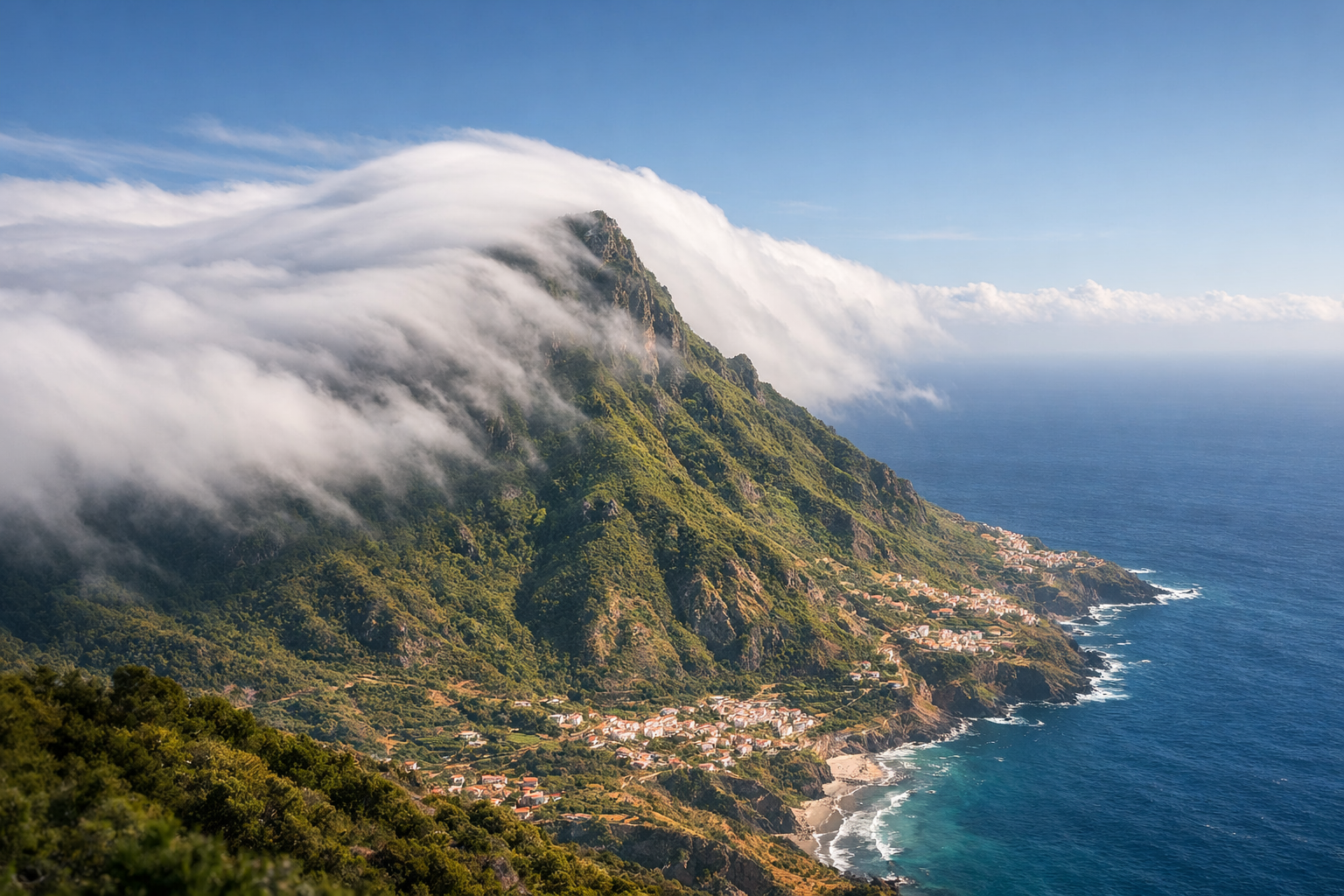
Scattered across the Atlantic roughly 100 kilometres west of Morocco and 1,100 kilometres southwest of mainland Spain, the eight Canary Islands sit in one of the world's most meteorologically privileged positions. The northeast trade winds, known locally as the Alisios, act as a natural thermostat—moderating summer heat and preventing the islands from turning arid and oppressive. The result is a year-round temperature band of 18–24°C at sea level, a relative humidity that stays comfortable on south and west-facing coasts, and more than 3,000 sunshine hours annually. Temperature rarely dips below 15°C in winter or climbs above 30°C in summer, making the Canaries as useful in January as they are in July. For 2026 travellers, this consistency is the single most compelling argument for choosing these islands over more fashionable but less reliable Mediterranean alternatives.
As an autonomous community of Spain and a full member of the European Union, the Canary Islands offer the reassurance of EU consumer protections, the euro, and Spanish-quality healthcare. What they additionally offer—and this matters enormously for shoppers and spirits enthusiasts—is duty-free status outside the EU customs territory. IGIC (the local VAT equivalent) sits at just 7%, compared with 21% on the mainland. For UK travellers post-Brexit, allowances apply when returning home, so checking current HMRC guidelines before stocking up on tobacco and alcohol is advisable.
The archipelago's population of approximately 2.2 million spreads across eight islands with wildly different characters. For most holidaymakers, the choice narrows to four: Tenerife, Gran Canaria, Lanzarote, and Fuerteventura. Each has a distinct personality, a different landscape signature, and a different ideal visitor profile. This guide breaks down what genuinely makes each one worth your time—and your money.
When to Book: Seasonal Strategy for 2026
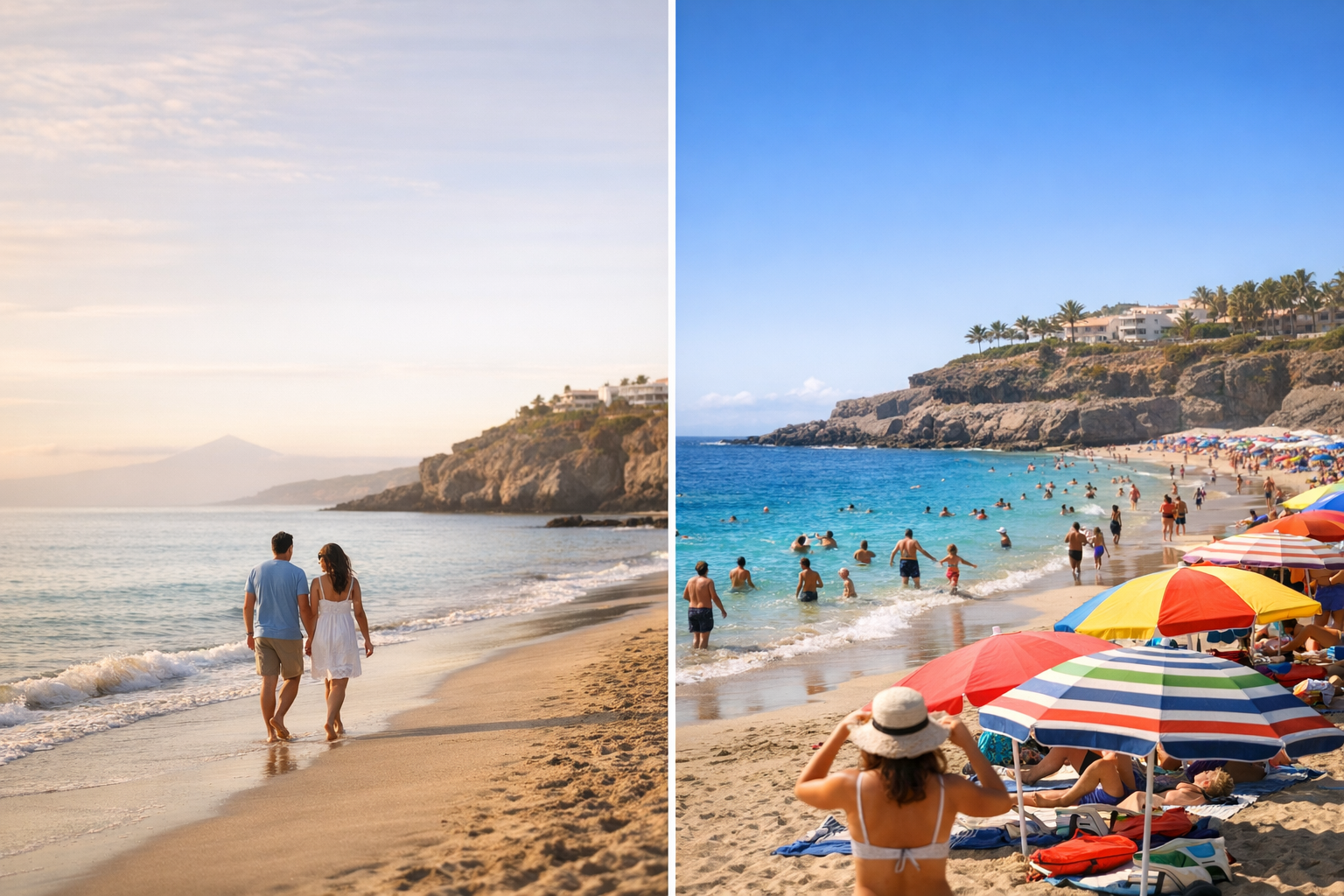
Timing a Canary Islands trip is less about finding good weather—which is virtually guaranteed regardless of month—and more about managing cost, crowds, and experience quality. Understanding the seasonal rhythm lets you stretch a travel budget considerably.
Peak Season (December–March) draws the largest wave of Northern Europeans fleeing grey winters. Daytime temperatures of 18–22°C feel positively balmy to visitors arriving from a Scottish or Scandinavian winter. Accommodation prices run 20–40% above annual averages, and return flights from the UK range from £180 to £350. Book hotels three to six months in advance and flights even earlier if you're targeting the Christmas or New Year period. The unmissable event of this window is the Carnival de Santa Cruz de Tenerife—expected in late February or early March 2026—a 10-day spectacle that rivals Rio de Janeiro in scale, featuring the Queen Gala election, massive street parades, and the theatrical Burial of the Sardine finale.
Shoulder Season (April–June and October–November) is the insider's choice. Temperatures climb pleasantly to 20–25°C, beach conditions are excellent, and return flights from UK regional airports with Ryanair, easyJet, or Jet2 can be secured for £80–£180. Hotel rates drop 10–25% relative to peak, and the islands' hiking trails and cultural sites are dramatically less crowded. Gran Canaria's WOMAD Las Palmas festival, typically held in late May or June, draws world-class musicians with sections open at no charge—a genuine bonus for culture-minded travellers. October and November are particularly brilliant for walking holidays in Tenerife's Anaga Rural Park, when the ancient laurel forests are misted and green.
Summer (July–September) sees the highest sea temperatures (22–24°C), making it ideal for snorkelling and watersports. However, the Calima—a Saharan dust wind that has grown more frequent and severe between 2023 and 2025—can push temperatures on Lanzarote and Fuerteventura to 38–42°C for days at a time. Families with school-age children have little choice but to travel in August, when Spanish and wider European holiday demand also peaks. Budget accordingly: flights run £120–£280 return, and accommodation fills fast.
For most independent travellers with flexibility, April–May and October represent the sweet spot: genuine value, ideal conditions, and enough visitor infrastructure to be comfortable without the resort crush of high season.
Getting There and Between Islands
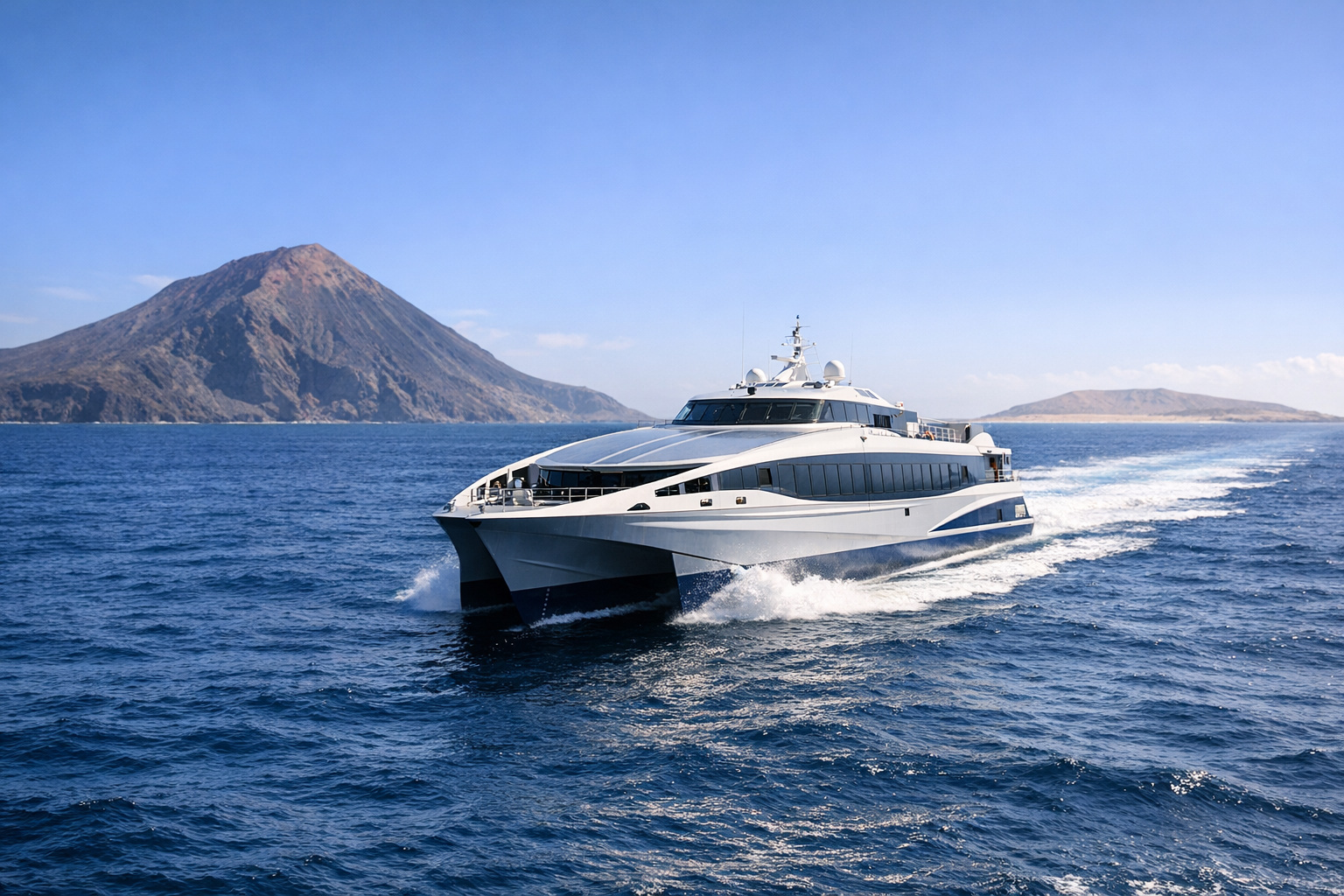
Five international airports serve the four main islands: Tenerife South (TFS) for the resort coast, Tenerife North (TFN) for Santa Cruz and Puerto de la Cruz—though it is notably prone to fog—Gran Canaria (LPA) in Las Palmas, Lanzarote (ACE), and Fuerteventura (FUE). From the UK, flight time is 4 to 4.5 hours from southern airports and marginally longer from Scottish ones.
Ryanair, easyJet, Jet2, and TUI between them cover almost every significant UK regional airport, with advance fares starting around £40 return on Ryanair's lowest promotional tariffs and averaging £80–£160 on easyJet and Jet2 outside peak periods. British Airways operates from London Heathrow to Gran Canaria and Tenerife, with returns from £120 and rising sharply over Christmas. Package deals from Jet2 and TUI frequently undercut the cost of booking flights and hotels separately, particularly for first-time visitors who want the security of ATOL protection.
Once in the archipelago, two modes of inter-island travel deserve serious consideration. Binter Canarias operates the dominant inter-island air network, connecting all four major islands in flights of 30–50 minutes; one-way fares range from €30 to €90, and the airline's Bono discount card rewards frequent island-hoppers. Book well ahead in July, August, and the Christmas period.
For travellers who prefer being at sea level, Fred. Olsen Express fast ferries and Naviera Armas conventional services cover the key routes. The standout option for a combined Lanzarote–Fuerteventura visit is the Corralejo–Playa Blanca crossing: just 25 minutes, departing frequently, and costing roughly €12–€18 one way. The Las Palmas (Gran Canaria) to Santa Cruz (Tenerife) Fred. Olsen fast ferry completes the journey in 1 hour 30 minutes for around €45–€65, while the Naviera Armas conventional service takes 4–5 hours but costs €25–€40—useful if you want to watch the ocean rather than race across it. Ferries can also carry rental cars for an additional €60–€150 per vehicle, which is worth considering if you've secured an excellent rate with a local hire company like Cicar.
For guests planning a multi-island itinerary, our [car hire planning guide](/car-hire/) and [airport transfer advice](/airport-transfers/) cover everything you need to move seamlessly between pick-up points.
Plan this trip
Compare Car Rentals
Compare 500+ suppliers — Hertz, Enterprise, Sixt & more.
Find Cars →Hotels in Canary Islands 4 Islands of Eternal Spring for Your Perfect
Top-rated hotels with free cancellation. Best price guaranteed.
Search Hotels →Vacation Rentals
Entire homes and condos — more space, more privacy.
Browse Rentals →Island 1: Tenerife — The Canaries' Volcanic Giant
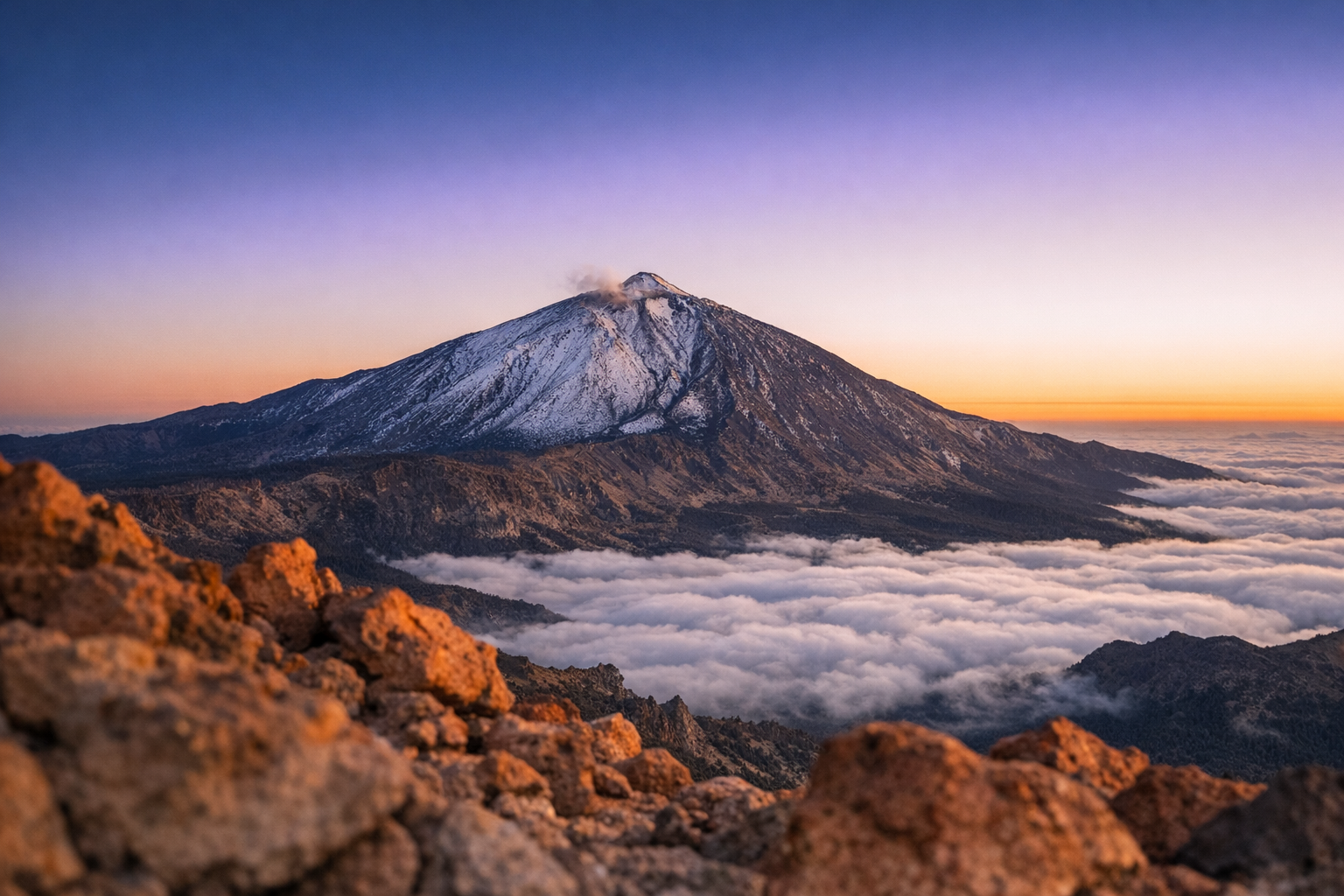
At 2,034 km² and home to roughly 900,000 residents, Tenerife is the largest and most populous island in the archipelago. Its defining feature—visible from neighbouring islands on clear days—is Mount Teide, a stratovolcano that rises to 3,715 metres, making it the highest point in Spain and the highest Atlantic island peak on Earth. Teide National Park was inscribed as a UNESCO World Heritage Site in 2007, and entry to the park itself is free. The cable car (Teleférico del Teide) costs €27 return for adults, reaches 3,555 metres in under eight minutes, and sells out weeks ahead in peak season—book online at telefericoteide.com. Summiting the final 160 metres to the crater rim requires a separate, free permit limited to 200 people per day through reservasparquesnacionales.es; these permits disappear months in advance. On the cable car's operating day, wind closures are common, so build in flexibility.
Beyond Teide, Tenerife divides neatly by coast. The south—Playa de las Américas, Costa Adeje, Los Cristianos—is sun-guaranteed, resort-dense, and commercially polished. The north, centred on Puerto de la Cruz, is greener, cooler between October and March, and more culturally layered. The Anaga Rural Park in the northeast corner is a UNESCO Biosphere Reserve protecting one of the world's finest surviving laurisilva (laurel forest) ecosystems. The Camino del Roy trail—12 kilometres from Cruz del Carmen to the ancient village of Taganana—takes four to five hours and rewards walkers with cloud-forest atmospheres unlike anything in southern Europe. TITSA bus 075 from Santa Cruz reaches Cruz del Carmen for €1.45 with a BONO card.
For families, Siam Park in Playa de las Américas has been voted the world's best water park on multiple occasions. Online advance tickets cost €42 for adults and €29 for children aged 3–11 (2025 pricing), with gate prices running around 10–12% higher. Loro Parque in Puerto de la Cruz—a zoo and marine park with one of Europe's largest primate collections—charges €38 adult and €25 child. Combined tickets for both parks are available for approximately €65 per adult.
Los Gigantes in the northwest presents 600–800 metre cliffs dropping sheer into the Atlantic—one of the most dramatic natural spectacles in the islands. Boat trips from Los Gigantes harbour last two hours, typically include a snorkelling stop, and cost €25–€45 per adult depending on vessel type. Cetacean sightings (pilot whales and bottlenose dolphins are resident species in the channel between Tenerife and La Gomera) are common year-round.
Masca village, perched in the Teno Mountains, draws hikers to its 4.5-kilometre gorge descent to the sea. The trail requires advance registration at reservas.tenerife.es (free; implemented after fire damage from overcrowding in 2019). A boat from the beach back to Los Gigantes costs approximately €18. The access road to Masca is narrow with severe hairpin bends—not recommended for nervous drivers or large vehicles. Arrive before 10:00 to secure parking (€3–€5) before tour coaches arrive.
Tenerife's accommodation spectrum runs from budget pensiones in Puerto de la Cruz at €40 per night to the Ritz-Carlton Abama in Guía de Isora from €350—a cliff-top resort with multiple Michelin-starred dining options and a Greg Norman–designed golf course. The Gran Hotel Bahía del Duque (from €280) in Costa Adeje remains a benchmark for Canarian architectural identity done at luxury scale. Mid-range visitors are well served by the H10 Costa Adeje Palace (adults-only, from €120) and the Iberostar Selection Anthelia (from €130).
On the plate, begin with papas arrugadas—small potatoes boiled in heavily salted water until their skins wrinkle, served with mojo rojo or mojo verde sauce. Ropa vieja (shredded beef and chickpea stew) is the archipelago's most satisfying main course, and bienmesabe (almond and honey cream) is the dessert you'll want to recreate at home. Denominación de Origen Tacoronte-Acentejo wines from the north of the island—made predominantly from the indigenous Listán Negro grape—are serious, underrated, and priced well below mainland Spanish equivalents. A three-course dinner with wine in a non-tourist restaurant in La Laguna or Garachico costs €20–€35 per person.
Island 2: Gran Canaria — The Miniature Continent
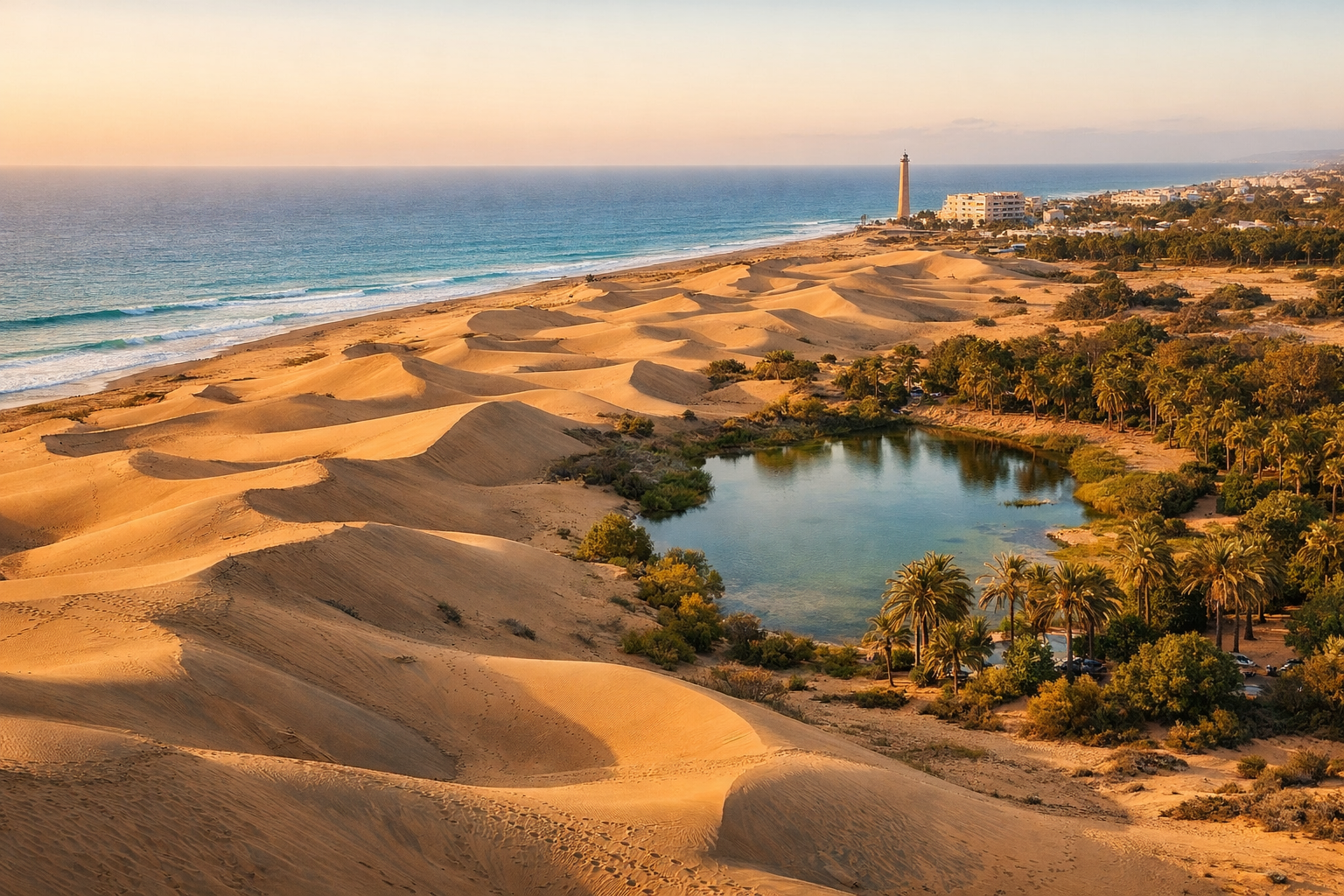
Gran Canaria earns its 'miniature continent' nickname through sheer geographical compression. Within 1,560 square kilometres, you move from the Saharan dune landscape of the south coast to the cloud-draped pine forests of Tejeda in the central mountains, then down to the cosmopolitan sprawl of Las Palmas de Gran Canaria—a city of 380,000 people that functions as the commercial and cultural capital of the entire archipelago. The contrast between these environments is available within a single day's drive.
The Maspalomas Dunes (Dunas de Maspalomas) are the island's headline attraction and deserve to be seen at first light before tour groups arrive. Four hundred hectares of shifting sand, protected as a nature reserve and free to enter, roll down to the Atlantic at the island's southern tip. Walking to the Faro de Maspalomas lighthouse at sunrise or sunset produces photographs of cinematic quality. The beach here divides naturally—Playa del Inglés to the east is commercially active and LGBTQ+-friendly with a well-established scene; Playa de Maspalomas to the west is quieter, with long-standing naturist sections.
Las Palmas itself rewards a full day's exploration. The Vegueta district—the original colonial settlement founded in 1478—contains the Cathedral of Santa Ana, the Casa de Colón (Christopher Columbus stayed here en route to the Americas in 1492; the museum is free on Sundays), and the Mercado de Vegueta, one of the most authentic covered markets in the Canaries. The city's Playa de las Canteras, a 3-kilometre urban beach protected by a natural reef, is consistently ranked among Europe's finest city beaches. The reef keeps the water calm enough for children to swim safely while providing a surf break further out.
Gran Canaria's interior is genuinely underexplored by package tourists. The Roque Nublo, a volcanic monolith standing 80 metres tall at 1,813 metres altitude, is reachable via a straightforward 3-kilometre return trail from the Cruz de Tejeda plateau. The views across the crater-shaped interior and on clear days to Teide on Tenerife are extraordinary. The village of Tejeda below the rock produces local almonds and the famous marzipan-like mazapán de Tejeda—buy directly from producers for authenticity.
Carnival in Gran Canaria runs in February 2026, approximately one week after Tenerife's main events conclude, giving island-hopping carnival enthusiasts the extraordinary option of attending both. Las Palmas's carnival centres on the capital's streets with similar queen galas and costume parades. WOMAD Las Palmas, typically scheduled for late May or early June, brings international world music artists to the city's Santa Catalina park, with free sections accessible to all.
For accommodation, Puerto Rico and Playa del Inglés offer the densest concentration of all-inclusive resorts, with strong competition keeping prices reasonable—mid-range all-inclusives from €90–€130 per person per night including food and drink. Las Palmas itself has seen boutique hotel development accelerate since 2020, with properties in the Vegueta and Triana districts offering superior cultural immersion at €80–€160 per night. Guests wanting to combine beach access with city life should look closely at hotels on or near Las Canteras beach.
Getting around independently requires either a rental car (essential for the interior mountains) or use of Global bus lines—the network covers most tourist areas and the city comprehensively, with fares typically under €2 for urban routes.
Plan this trip
Compare Car Rentals
Compare 500+ suppliers — Hertz, Enterprise, Sixt & more.
Find Cars →Hotels in Canary Islands 4 Islands of Eternal Spring for Your Perfect
Top-rated hotels with free cancellation. Best price guaranteed.
Search Hotels →Vacation Rentals
Entire homes and condos — more space, more privacy.
Browse Rentals →Island 3: Lanzarote — The Artist's Volcanic Canvas
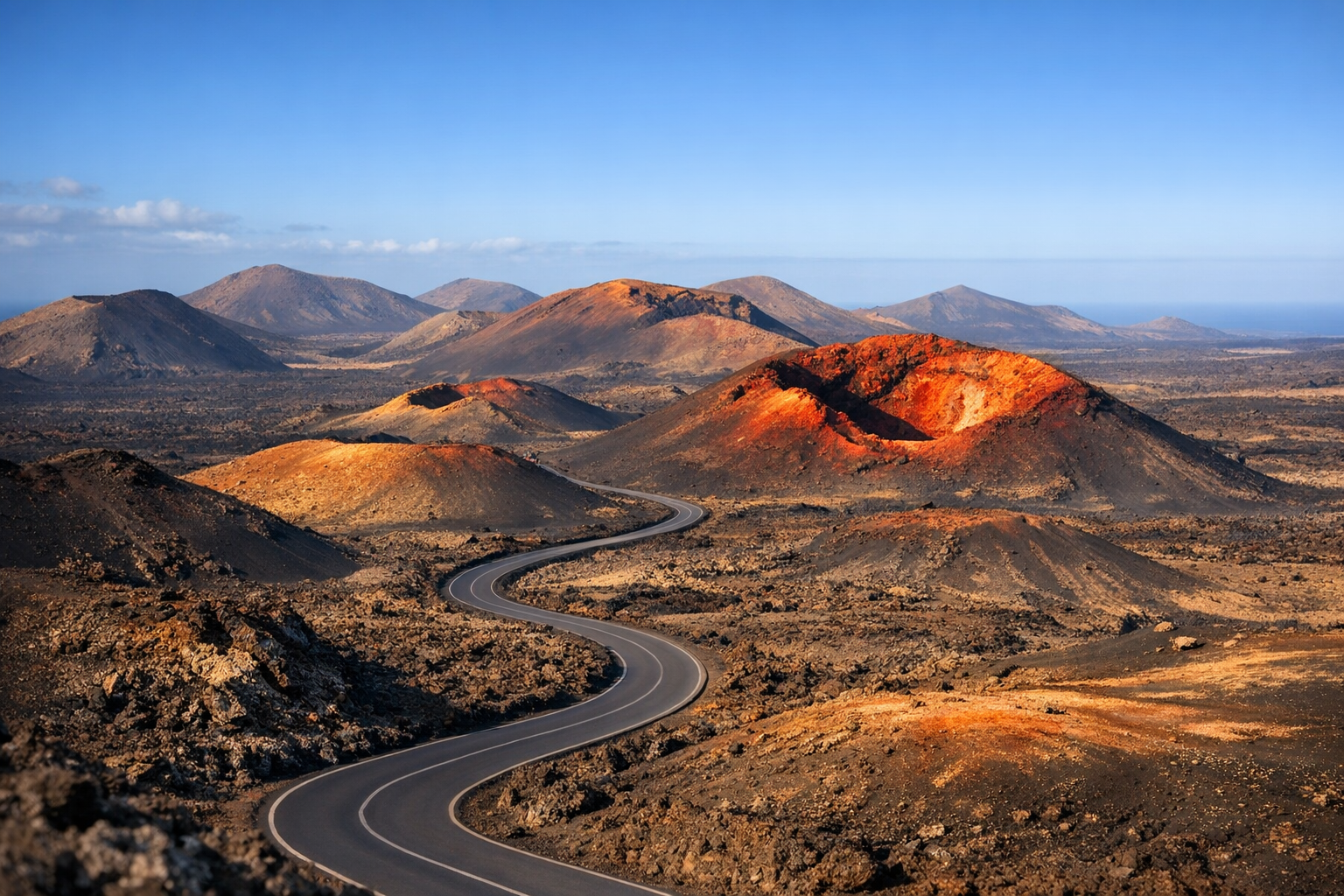
Lanzarote is unlike any other inhabited island in Europe. Between 1730 and 1736, a series of eruptions—among the longest sustained volcanic episodes in recorded history—buried a third of the island under lava fields called Timanfaya. Today, that landscape of jet-black basalt, ochre craters, and red volcanic cones constitutes the Timanfaya National Park, a UNESCO Biosphere Reserve where geothermal heat is so intense that rangers demonstrate the effect by pouring water into a pipe sunk into the rock, producing an instant geyser. Entry to the park costs €12 for adults and €6 for children; the mandatory Ruta de los Volcanes coach tour within the park is included. Private vehicles cannot drive the crater route—only official park buses.
Timanfaya is one story. The other is César Manrique. The Lanzarote-born artist and architect (1919–1992) essentially designed the modern island, brokering an agreement with local authorities to restrict building heights, ban roadside billboards, and mandate that new construction respect the island's colour palette of white, black, and green. His influence is visible everywhere—from the volcanic-cave concert hall of the Jameos del Agua (€11 adult) to the Fundación César Manrique, built inside five interconnected volcanic bubbles beneath his former home in Tahíche (€12 adult, closed Mondays). The Jardín de Cactus (€6.50 adult), a cactus garden of extraordinary sculptural precision set in an old quarry, was his last completed public project before his death in a car accident near its entrance. Together these sites constitute one of Europe's most coherent exercises in integrating art, architecture, and volcanic landscape.
The island's beaches divide by character. Playa Blanca in the south is calm, sheltered, and suited to families. The Papagayo beaches—accessible via a dirt road (€3 toll) or boat from Playa Blanca—are among the most scenically perfect coves in the archipelago, with clear turquoise water sheltered by volcanic cliffs. In the north, Famara beach stretches 6 kilometres of raw Atlantic surf, making it the island's premier surfing and kitesurfing location; lessons and equipment hire are available from multiple schools in the small village behind the dunes.
Lanzarote's wine culture is genuinely extraordinary and frequently surprises visitors. The La Geria wine region occupies a lava field where farmers have spent centuries constructing individual volcanic-rock windbreaks (socos) around each vine, protecting them from the Alisios while capturing night-time moisture. The result—wines from the Malvasía Volcánica grape with a distinctive mineral character—has earned DO Lanzarote certification. El Grifo, the oldest winery in the Canaries (founded 1775), offers tastings from €8 at their museum winery near Masdache. Bodega La Geria provides a more rustic experience with panoramic views across the crater landscape.
Practically speaking, a rental car is near-essential on Lanzarote. The island is compact (845 km²) but public transport is limited outside the main resorts. From the airport at Arrecife, all major attraction clusters are within 30–40 minutes. Calima events—Saharan dust episodes—are more frequent here than on the western islands; they typically last 2–5 days and are impossible to predict more than 24–48 hours in advance.
For the ferry connection to Fuerteventura (the Corralejo–Playa Blanca service), check Naviera Armas and Fred. Olsen for combined day-trip or island-hop packages. At 25 minutes crossing time, this is the easiest inter-island hop in the archipelago. Our [travel planning services page](/travel-planning/) covers multi-island itinerary support for those combining both islands.
Island 4: Fuerteventura — The Saharan Shore of the Atlantic
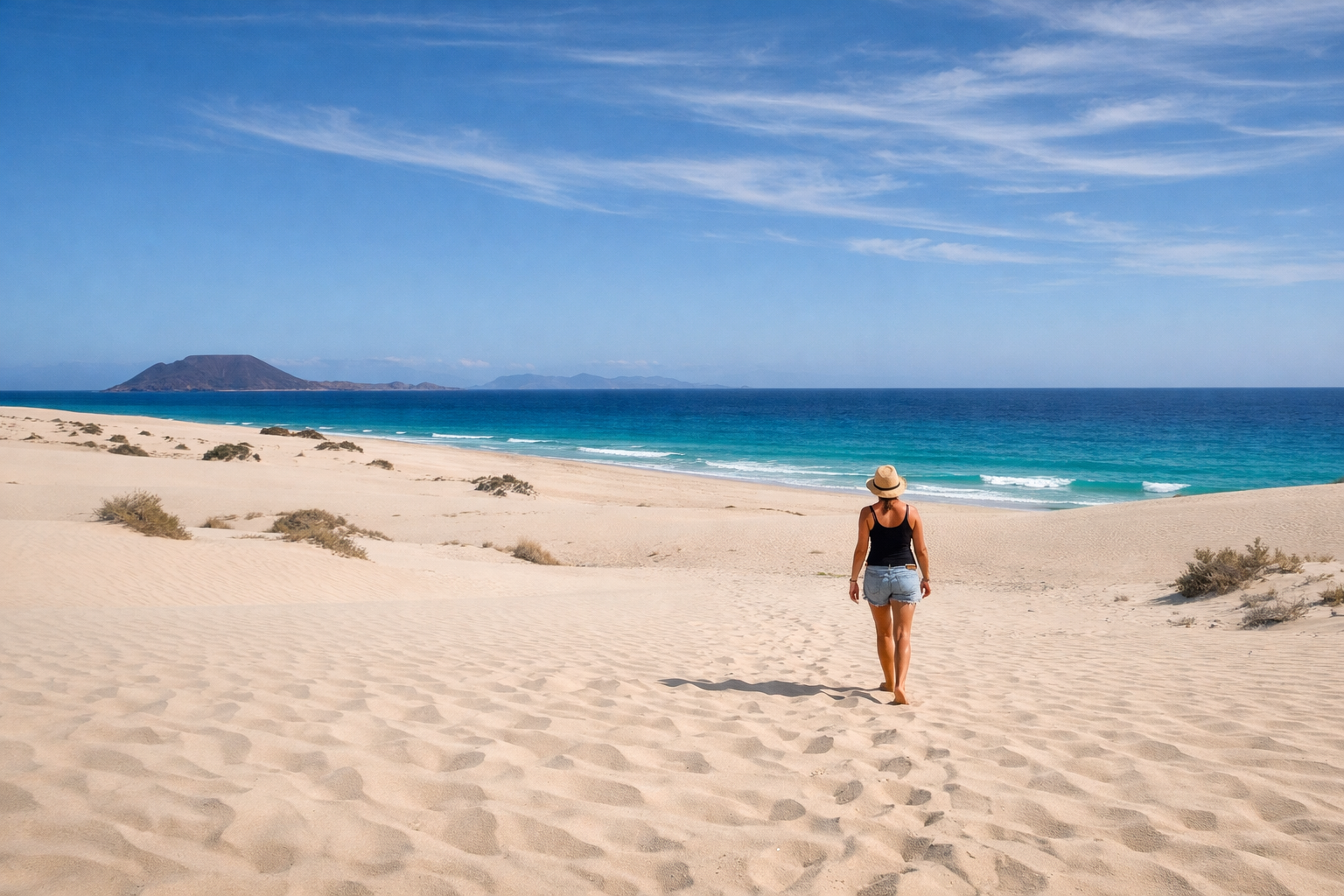
Fuerteventura is the second-largest Canary Island at 1,660 km² and the closest to the African continent—just 97 kilometres from the Moroccan coast at its nearest point. That proximity explains everything about its character: the landscape is genuinely desert-like, dominated by flat plains of ochre rock, ancient eroded volcanoes, and—most spectacularly—the Corralejo Natural Park in the north, where white quartz sand dunes up to 10 kilometres long sweep down to waters of Caribbean clarity.
Where Lanzarote dazzles with volcanic drama and Tenerife with altitude, Fuerteventura's genius is in its beaches. It has more beach area than any other Canary Island—approximately 150 kilometres of coastline—and the quality is consistently exceptional. Playa de Sotavento on the Jandia peninsula hosts a lagoon that migrates with the tides, creating ideal flatwater conditions for windsurfing and kitesurfing. The PWA Windsurfing World Cup has been held here repeatedly; for 2026, check pwaworldcup.com for confirmed dates. Equipment rental and lessons for all skill levels are available in Risco del Paso village beside the lagoon, with beginner packages starting around €50 for a 2-hour session.
Corralejo in the north is the island's most animated town—compact, genuinely walkable, with a working harbour alongside the tourist infrastructure. The beach immediately north of the old town is narrow and busy, but the natural park dunes begin within walking distance and their scale quickly absorbs any crowds. The ferry terminal here provides the 25-minute crossing to Playa Blanca in Lanzarote, making Corralejo an ideal base for a dual-island itinerary.
The Betancuria valley in the island's interior is a world away from the beach resorts. The former capital—established in 1404 and the first European settlement in the Canary Islands—sits in a sheltered green valley that feels almost Andalusian. The 15th-century Church of Santa María de Betancuria contains intricate Mudéjar woodwork and is one of the oldest churches in the archipelago; entry is typically under €2. The Museo Arqueológico (€2 adult) in the adjacent village of Antigua documents the island's pre-Hispanic Majorero people and their goat-herding civilisation.
Fuerteventura's goats are not merely historical artefacts—the island has more goats than people (roughly 70,000 goats against a human population of approximately 120,000), and Majorero goat cheese (Queso Majorero) holds a Protected Designation of Origin. It is produced in three formats—fresh, semi-cured, and cured, the latter sometimes coated in roasted paprika or gofio (toasted grain flour). Buy it directly from farms signposted along the GC-10 road for a fraction of resort restaurant prices.
Practically, Fuerteventura divides geographically: the north (Corralejo, El Cotillo) suits independent travellers, surfers, and those wanting a town base; the south (Jandia, Morro Jable) suits beach-focused and watersports visitors and has the most all-inclusive resort concentration. The island is flat enough that cycling is genuinely viable—rental operators in Corralejo and Caleta de Fuste offer quality bikes from €15–€25 per day. Car hire remains the most flexible option for covering both halves of the island on a single trip, and we recommend comparing rates early through our [car hire partners page](/car-hire/) before airport-desk pricing takes hold.
For accommodation, Fuerteventura has seen strong growth in boutique and adults-only properties since 2022. The Iberostar Fuerteventura Palace in Jandia (from €110/night) and the Barceló Corralejo Bay (from €90/night) represent solid mid-range choices. Self-catering apartments through trusted platforms suit longer stays particularly well—studio apartments in Corralejo can be found from €45–€70 per night for two people, with access to a shared pool and full kitchen facilities.
Plan this trip
Compare Car Rentals
Compare 500+ suppliers — Hertz, Enterprise, Sixt & more.
Find Cars →Hotels in Canary Islands 4 Islands of Eternal Spring for Your Perfect
Top-rated hotels with free cancellation. Best price guaranteed.
Search Hotels →Vacation Rentals
Entire homes and condos — more space, more privacy.
Browse Rentals →Practical Essentials: Planning Your Canary Islands Trip for 2026
A few logistical realities can make the difference between a smooth Canary Islands holiday and a frustrating one. First, the time zone: the islands run on GMT/UTC year-round, the same as the UK (clocks change simultaneously with UK and European daylight saving), meaning no jet lag adjustment is needed from Britain and only one hour's difference from mainland Spain. Mobile roaming for UK visitors technically falls outside EU roaming rules since Brexit, but most major UK carriers (EE, Vodafone, Three, O2) do include the Canary Islands in their roaming packages as of 2025—verify with your specific provider before departure.
Car hire is almost non-negotiable for exploring beyond resort perimeters on any of the four islands. Cicar, the Canary Islands–based local operator, consistently undercuts international chains and maintains a quality fleet; compare their rates alongside Europcar and Enterprise before committing. Economy cars are available from €25–€50 per day, though summer and Christmas peak periods push prices higher. Booking 6–8 weeks ahead and opting for full insurance coverage (to avoid excess liability) is the standard recommendation. Our [car hire guide](/car-hire/) contains practical advice on reading the fine print on Canary Islands rental agreements, which differ from mainland Spain policies in specific ways.
Healthcare works as follows: EU citizens present their European Health Insurance Card (EHIC) or Global Health Insurance Card (GHIC) for access to the Spanish public health system on the same terms as Spanish nationals. UK travellers should carry a UK GHIC (free from the NHS website). Private travel insurance is still strongly recommended given waiting times at public hospitals in peak tourist months and the cost of repatriation if needed.
Tipping culture is relaxed: rounding up a bill or leaving 5–10% for good service is appreciated but not expected in the way it is in the United States. Taxi drivers do not typically expect tips. At hotel bars and resort restaurants where service charges are sometimes added automatically, check your bill before adding more.
Finally, environmental awareness matters increasingly on these islands. Tenerife in particular has seen growing tension between tourism capacity and ecological sustainability, with overtourism protests in 2024 drawing international attention. Respecting no-go zones (hiking Masca Gorge without registration carries fines), carrying reusable water bottles (tap water is generally safe to drink in hotels, though desalinated and mineral water is preferred by locals in some areas), and choosing locally owned restaurants over international chains all contribute to a tourism footprint the islands can sustain. For comprehensive pre-trip logistics including transfers, itinerary planning, and accommodation matching, our [holiday planning services](/holiday-planning/) page provides personalised support.
Frequently Asked Questions
Tenerife is the most logical first choice for most travellers—it offers the greatest variety of landscapes (from beach to 3,715-metre volcano), the widest accommodation range from budget to ultra-luxury, the most comprehensive public transport network, and the best inter-island connections. Gran Canaria is a strong second choice for those who want a city element (Las Palmas) alongside beach time. Lanzarote suits travellers drawn to art, architecture, and dramatic volcanic scenery. Fuerteventura is the first choice for beach purists and watersports enthusiasts.
No. The Canary Islands are part of Spain, an EU member state, and UK citizens can visit as tourists for up to 90 days in any 180-day period under the EU's short-stay visa rules for non-EU nationals post-Brexit. No visa is required for tourism. The EU Entry/Exit System (EES) and ETIAS pre-travel authorisation system may be operational by 2026—check the UK Government's travel pages and the EU's official ETIAS website for current status before departure.
Yes, particularly for trips of 10 days or more. The easiest combination is Lanzarote and Fuerteventura, connected by the 25-minute Corralejo–Playa Blanca ferry for approximately €12–€18 each way. Tenerife and Gran Canaria pair well via Fred. Olsen's 1.5-hour fast ferry between Santa Cruz and Las Palmas (€45–€65 one way). For shorter trips of 7 days or fewer, focus on one island—the Canaries reward slow exploration rather than rapid ticking.
The Calima is a wind carrying Saharan dust from the African mainland, capable of pushing island temperatures from a comfortable 25°C to 38–42°C within hours. Visibility drops, the sky turns a milky orange, and outdoor activities become uncomfortable. Episodes typically last 2–5 days and have become more frequent during summer months between 2023 and 2025. Lanzarote and Fuerteventura, being closest to Africa, are most affected. If caught in a Calima, focus on air-conditioned museums, caves, or wine cellars—and remain well hydrated.
For travel between December and March or during July and August, book as soon as your dates are confirmed—the cable car sells out 4–6 weeks ahead in peak season. Shoulder months (April–June, October–November) offer more flexibility, but booking at least 2 weeks ahead is still advisable. If you also want the summit permit to walk the final 160 metres to the crater rim, apply for that separately at reservasparquesnacionales.es as soon as it opens for your dates—200 permits per day are released and they go quickly, often months in advance for peak season dates.
Tap water in the Canary Islands is technically safe to drink and meets EU standards, as it is produced primarily through desalination plants. However, locals and long-term residents typically prefer bottled or filtered water due to taste considerations associated with the desalination process. In hotels, tap water is generally fine for teeth brushing and cooking. For everyday drinking, carrying a reusable bottle and refilling from hotel filtered water points is the most practical and environmentally considerate approach.
Playa de las Teresitas near Santa Cruz de Tenerife offers calm, sheltered golden-sand swimming with no undertow—ideal for young children. In Gran Canaria, Las Canteras beach in Las Palmas is protected by a natural reef that keeps waters exceptionally calm. Playa Blanca in Lanzarote's south is sheltered and shallow. In Fuerteventura, the Caleta de Fuste beach near the airport is purpose-built for family use, with calm waters, sunbed facilities, and resort infrastructure immediately adjacent. Avoid exposed Atlantic-facing beaches such as Famara (Lanzarote) and El Cotillo (Fuerteventura) with children—wave energy and currents can be dangerous.
Plan this trip
Compare Car Rentals
Compare 500+ suppliers — Hertz, Enterprise, Sixt & more.
Find Cars →Hotels in Canary Islands 4 Islands of Eternal Spring for Your Perfect
Top-rated hotels with free cancellation. Best price guaranteed.
Search Hotels →Vacation Rentals
Entire homes and condos — more space, more privacy.
Browse Rentals →