Why Jamaica Remains One of the Caribbean's Top Destinations in 2026
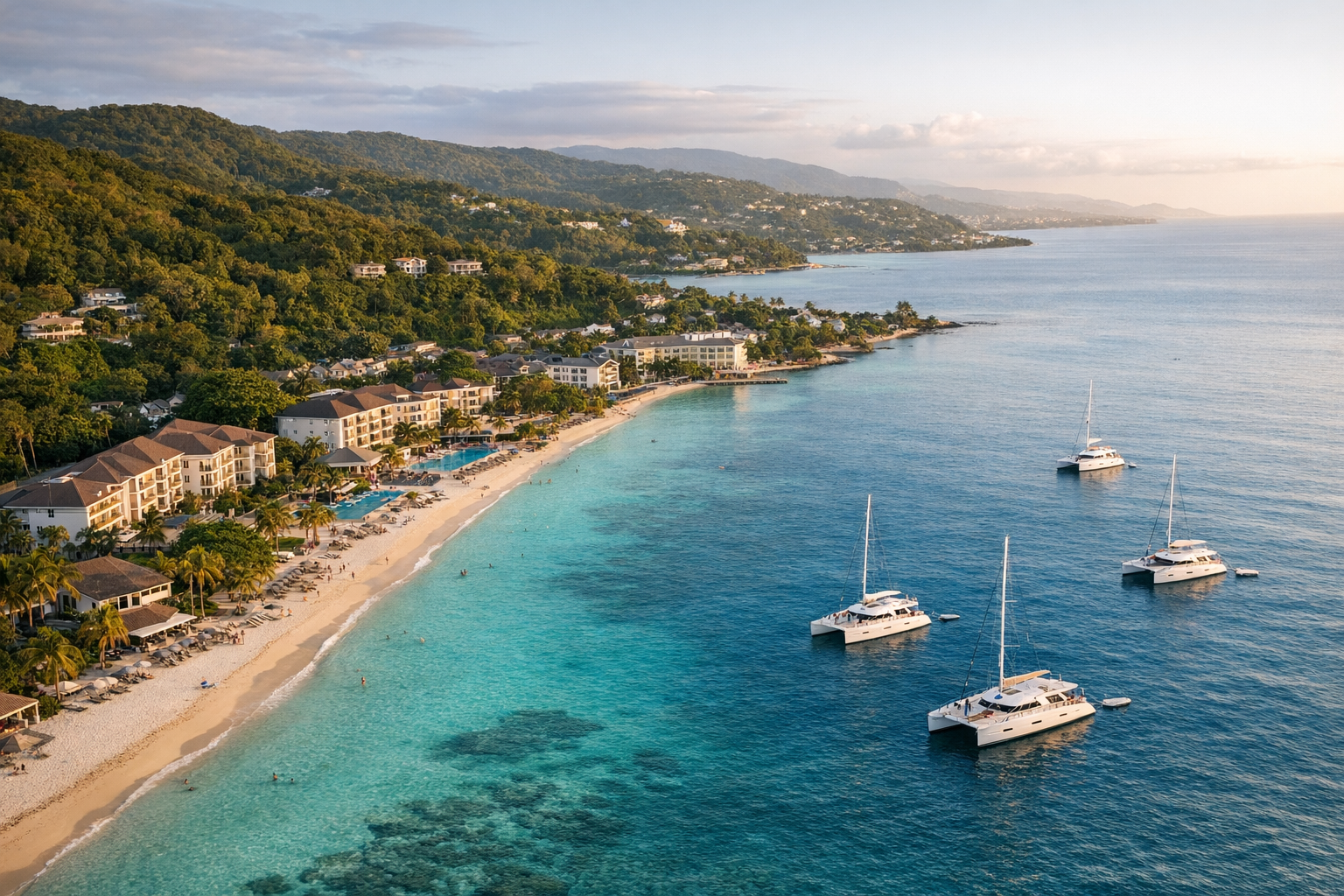
Jamaica consistently ranks among the most visited islands in the Caribbean, and for good reason. With three distinct resort corridors—Montego Bay on the northwest coast, Negril on the far west, and Ocho Rios on the north—the island offers genuinely different travel experiences within a land area of just 10,990 square kilometres (4,244 square miles). Whether you are chasing the legendary seven-mile stretch of white sand, the cliff-diving spectacle of the West End, or the thundering waterfalls near Ocho Rios, Jamaica delivers a depth of experience that few islands can match.
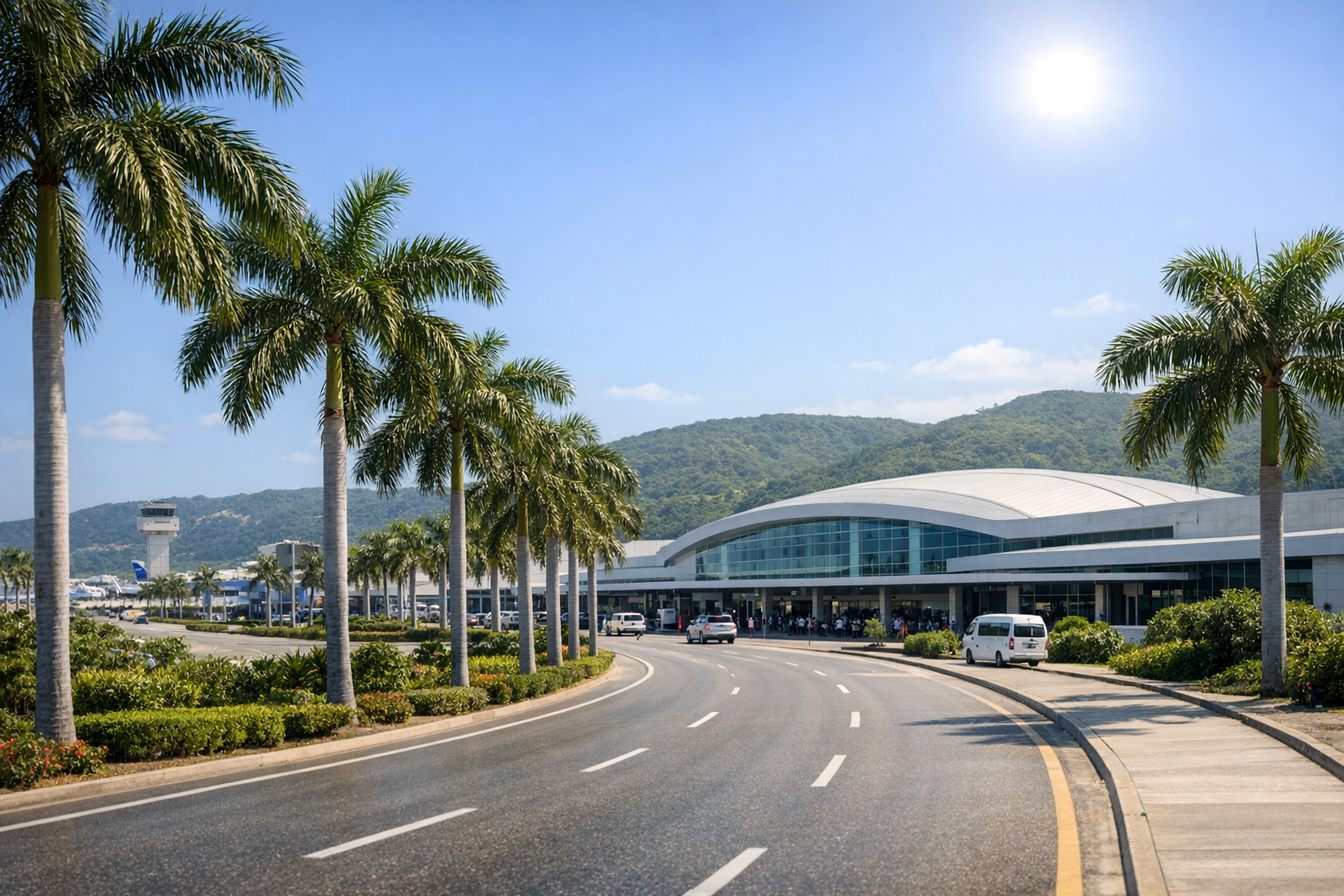
The country welcomed approximately 4.3 million stopover visitors in 2023 according to the Jamaica Tourist Board, a figure that continues to climb as airlift expands and all-inclusive resort development matures. For 2026, the fundamentals remain strong: Sangster International Airport (MBJ) in Montego Bay handles direct service from every major U.S. hub, Toronto, and London, making access straightforward for North American and European travellers alike. Flights from New York clock in at roughly 3.5 hours, and from Miami the journey is barely 90 minutes in the air.
Choosing between the three main destinations, however, is where most first-time visitors stumble. Each resort town has a distinct personality, a different price ceiling, and a specific traveller profile it serves best. This guide breaks down everything you need to know—entry requirements, transport logistics, the honest cost of each destination, and the seasonal timing that separates a good Jamaica trip from a great one.
Entry Requirements & Pre-Departure Essentials for 2026
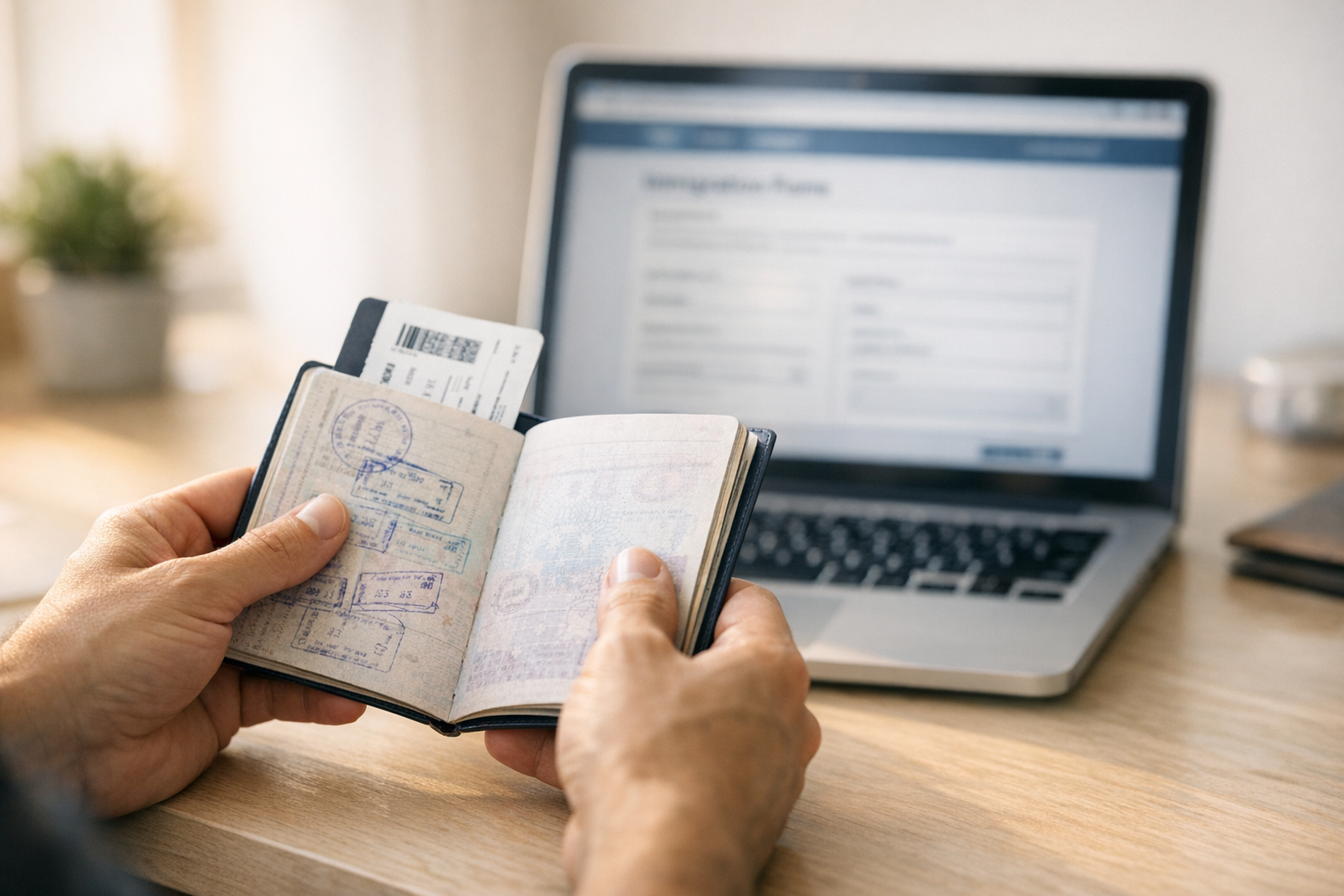
Jamaica replaced its paper immigration form with a fully digital system in 2023. Called the Immigration and Customs Authorization (ICA)—sometimes referred to as the C5 digital card—this pre-departure declaration must be completed online at travelauthorization.mygov.jm before you board your flight. The process takes five to ten minutes, costs nothing, and is mandatory for all non-Jamaican nationals regardless of citizenship.
Citizens of the United States, Canada, the United Kingdom, and European Union member states do not require a visa for stays of up to 90 days. You will, however, need to present a valid passport, a confirmed return or onward ticket, and proof of accommodation upon arrival. Unlike many destinations, Jamaica does not enforce the standard six-month passport validity rule for most western nationalities—your passport simply needs to remain valid for the duration of your stay. That said, checking the specific guidance published by Jamaica's Passport, Immigration and Citizenship Agency (PICA) ahead of travel is always advisable, as policies can update between booking and departure.
For health requirements, Jamaica lifted all COVID-era testing and vaccination mandates and had no standing health-related entry restrictions as of early 2025. Travel insurance is not legally required but is strongly recommended given the out-of-pocket medical costs at private facilities, which cater to the majority of tourists. A solid policy covering emergency evacuation, trip cancellation, and medical treatment typically costs USD $50–$120 for a one-week Caribbean trip depending on your age and coverage level.
Getting to Jamaica: Flights, Airports & What to Expect at MBJ
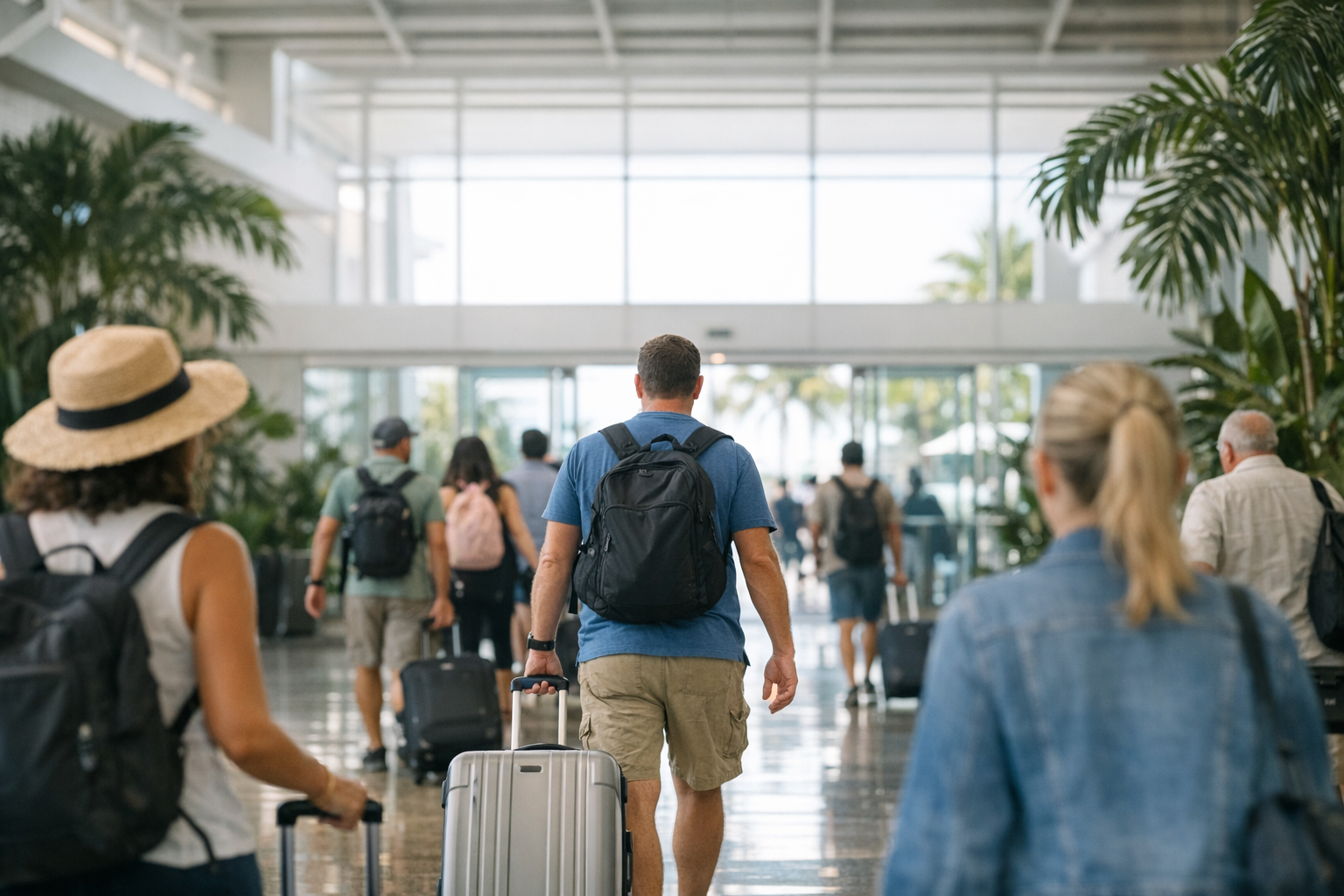
Sangster International Airport (IATA: MBJ) in Montego Bay is the primary gateway for leisure travellers and handles the vast majority of tourist arrivals. Norman Manley International Airport (KIN) in Kingston processes mostly domestic and business traffic and is inconveniently located for anyone heading to the resort corridors on the north and west coasts. Unless you have specific business in the capital, book into MBJ.
Roundtrip economy fares from major U.S. departure cities in 2025–2026 reflect a broad range depending on season and how early you book. From New York (JFK or EWR), expect to pay USD $280–$550 in the off-peak period and USD $450–$800 during peak winter months. Miami is the cheapest U.S. market at roughly USD $200–$420 roundtrip, served by American Airlines, JetBlue, and Spirit among others. Delta dominates the Atlanta corridor at USD $280–$500, while Chicago travellers typically see fares ranging from USD $350–$650. Canadian visitors flying from Toronto pay roughly CAD $450–$900 roundtrip with Air Canada, WestJet, or Sunwing. From London, British Airways and Virgin Atlantic offer direct service to MBJ in the USD £450–£900 roundtrip range, with the flight lasting approximately ten hours.
The arrivals experience at MBJ has improved considerably with the expansion of Terminal D. Once through immigration and customs—a process that can take 30–60 minutes at peak times—you will exit into a gauntlet of taxi and transfer touts. Stick to JUTA-licensed taxis (identifiable by yellow licence plates with a PPV designation) or pre-booked private transfers. For travellers heading directly to the Montego Bay hotel strip or Rose Hall, a JUTA fare runs USD $15–$25. If you have arranged a luxury villa or a remote property, pre-booking a private transfer through a reputable service will save the negotiation hassle entirely. Our guide to [private airport transfers and ground transportation](/private-airport-transfers/) covers what to look for when vetting transfer providers.
Plan this trip
Hotels in Planning & Tips
Top-rated hotels with free cancellation. Best price guaranteed.
Search Hotels →Compare Car Rentals
Compare 500+ suppliers — Hertz, Enterprise, Sixt & more.
Find Cars →Hotels in Planning & Tips
Top-rated hotels with free cancellation. Best price guaranteed.
Search Hotels →Vacation Rentals
Entire homes and condos — more space, more privacy.
Browse Rentals →Getting Around Jamaica: Transfers, Buses, Taxis & Car Rental Explained
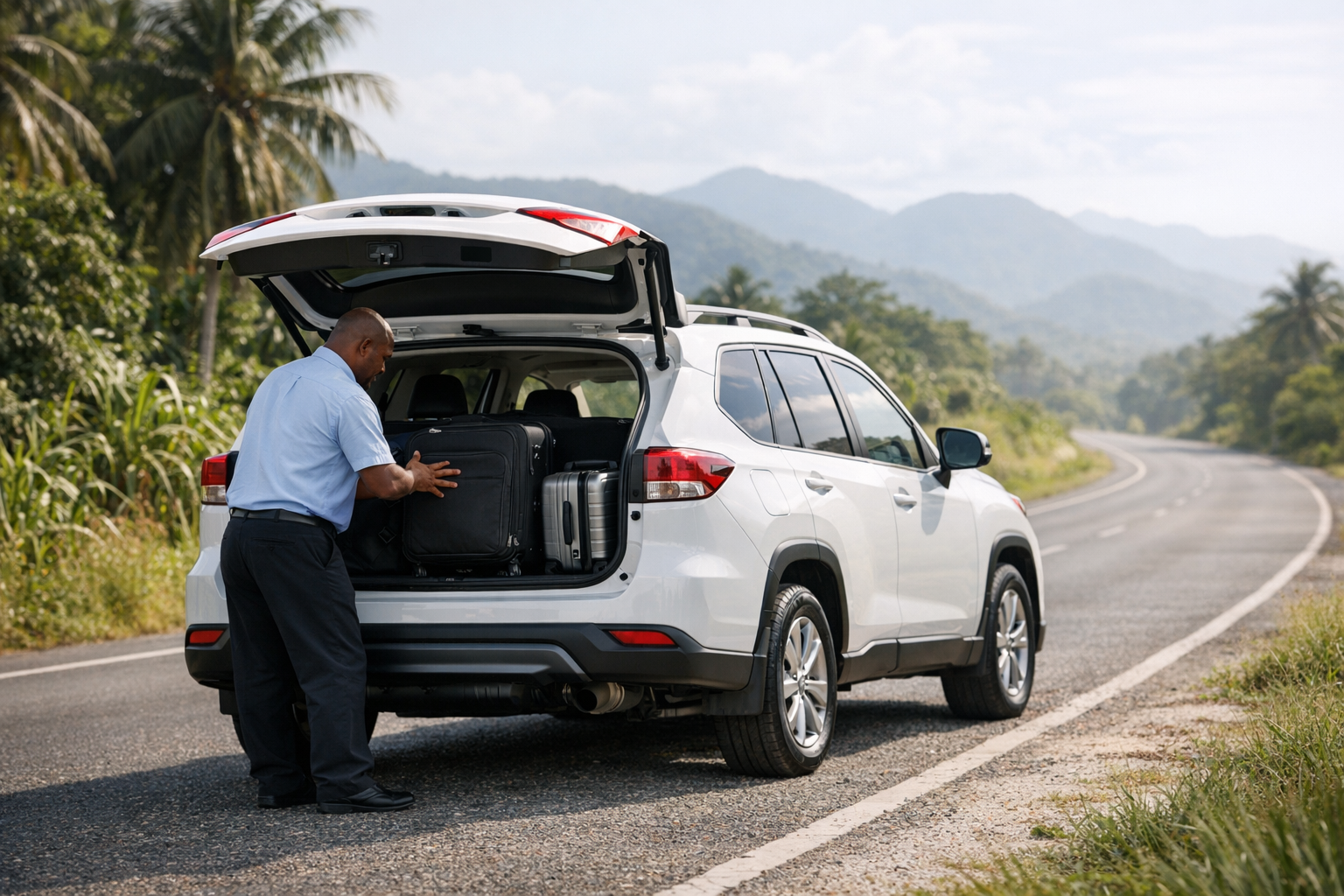
Transportation is the single logistical factor that most disrupts Jamaica holidays that are not all-inclusive. Understanding your options before you land will save both money and frustration.
Knutsford Express — The Reliable Middle Ground For travellers not renting a car, Knutsford Express (knutsfordexpress.com) is the most dependable intercity option. Air-conditioned coaches with luggage storage depart from the Montego Bay area on scheduled timetables, with seats bookable online in advance. The MBJ-to-Negril journey costs approximately USD $20–$25 and takes 1.5–2 hours. Ocho Rios runs are priced at USD $20–$28 one-way. This service is a legitimate step up from route taxis in terms of comfort and predictability, and it is used by both budget travellers and mid-range visitors who prefer not to drive.
Route Taxis — Cheap but Chaotic Shared route taxis—typically Toyota Corolla station wagons—are the cheapest way to move between towns, with inter-town fares running USD $3–$8 depending on distance. They depart when full rather than on a schedule, which can mean waiting 20–40 minutes with luggage in tropical heat. Short local rides within a resort town run USD $1–$3. They are perfectly safe but are not practical for airport transfers with significant luggage.
Renting a Car — Best for Flexibility Driving in Jamaica requires adjusting to left-hand traffic (the same as the UK and Australia). An International Driving Permit is recommended though not strictly enforced for most nationalities. Economy car rental from major operators at MBJ (Avis, Budget, Hertz) runs USD $40–$80 per day; an SUV with higher ground clearance—useful on rural roads—costs USD $80–$150 per day. Island Car Rentals, a locally-owned company with strong traveller reviews, is worth comparing against the multinationals. Fuel costs approximately USD $1.40–$1.60 per litre (roughly USD $5.30–$6.00 per gallon) at 2025 prices. Main highways between the resort towns are in reasonable condition; secondary roads, particularly in hilly interior areas, can be severely potholed. If your itinerary involves multiple destinations across several days, a rental car almost always works out more cost-efficient and time-efficient than piecing together transfers.
Private Transfers — Worth Every Dollar for Longer Routes A private transfer from MBJ to Negril costs approximately USD $80–$120 for the whole vehicle (not per person), making it competitive for couples or small groups. Ocho Rios transfers from MBJ run USD $90–$140 for a private car. For multi-destination itineraries or anyone travelling with children, pre-arranged private transfers remove the uncertainty of negotiating at the kerbside after a long flight. Our [luxury ground transportation resource page](/luxury-ground-transportation/) outlines how to vet transfer providers and what questions to ask before booking.
Best Time to Visit Jamaica: Season-by-Season Breakdown
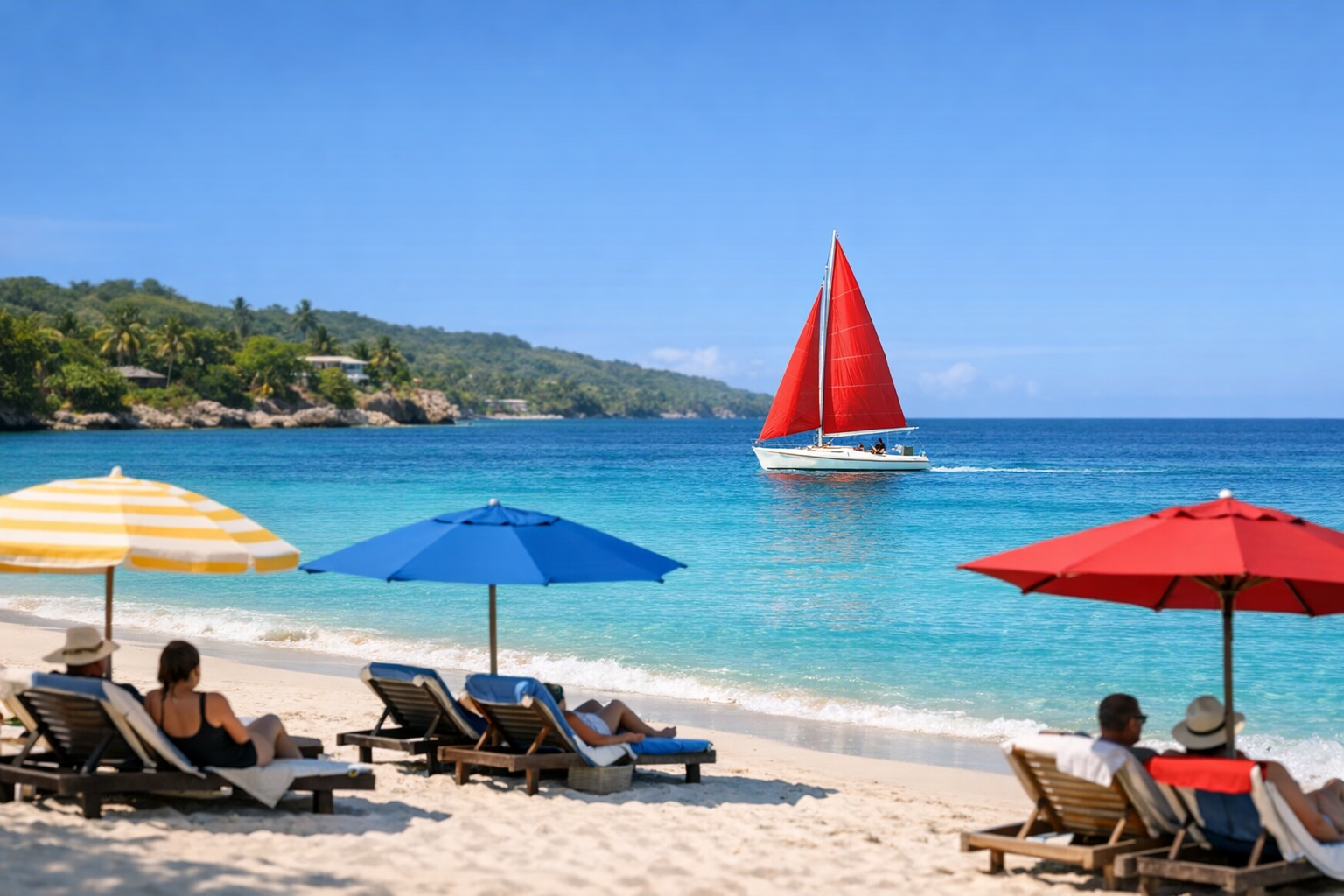
Jamaica sits firmly in the tropics at approximately 18 degrees north latitude, which means temperatures remain warm year-round—ranging from 24°C to 32°C (75°F to 90°F) at sea level. The difference between seasons is less about temperature and more about rainfall, humidity, crowds, and cost.
Peak Season (Mid-December through April) This is dry season Jamaica at its best: low humidity, steady trade wind breezes, and day after day of reliable sunshine. Temperatures hover between 24°C and 28°C (75°F and 82°F). It is also when hotel rates run 30–60% higher than the rest of the year, particularly around Christmas, New Year's, and the February–March spring break window. Book three to six months ahead for peak-season travel, especially if targeting specific properties like Round Hill or Sandals.
Shoulder Season (May, June, November) May and June bring the beginning of the rainy season, but showers tend to be brief afternoon affairs rather than all-day deluges. November signals the end of hurricane season and offers some of the island's best value pricing. Expect rates 15–25% below peak, far fewer crowds at attractions, and perfectly swimmable water temperatures. November also aligns with the Negril Music Festival, which draws a more culturally interested crowd than the mega-resort crowd of February.
Off-Peak / Rainy Season (July–October) Hurricane season peaks between August and October, and while Jamaica does not sustain a direct hit every year, the risk is real and travel insurance becomes non-negotiable during this window. Humidity rises noticeably, and afternoon thunderstorms are common. The upside is dramatic: hotel rates drop 30–50% below peak, resort occupancy is low, and the island's natural landscape is at its most lush and vivid. Many experienced Jamaica travellers deliberately visit in September or early October for precisely this reason.
Events Worth Planning Around Reggae Sumfest in Montego Bay—Jamaica's largest music festival—typically falls in mid-July and causes hotel rates in MoBay to double or even triple during festival week. The Jamaica Carnival (April, pre-Easter) brings vibrant street parades to Kingston and Montego Bay. The Ocho Rios Jazz Festival runs in June, and Montego Bay hosts an annual Jazz & Blues Festival in January or February. If any of these events align with your interests, book accommodation the moment your travel dates are confirmed—inventory disappears quickly.
Plan this trip
Hotels in Planning & Tips
Top-rated hotels with free cancellation. Best price guaranteed.
Search Hotels →Compare Car Rentals
Compare 500+ suppliers — Hertz, Enterprise, Sixt & more.
Find Cars →Hotels in Planning & Tips
Top-rated hotels with free cancellation. Best price guaranteed.
Search Hotels →Vacation Rentals
Entire homes and condos — more space, more privacy.
Browse Rentals →Montego Bay: Best for First-Timers, Families & Resort Variety
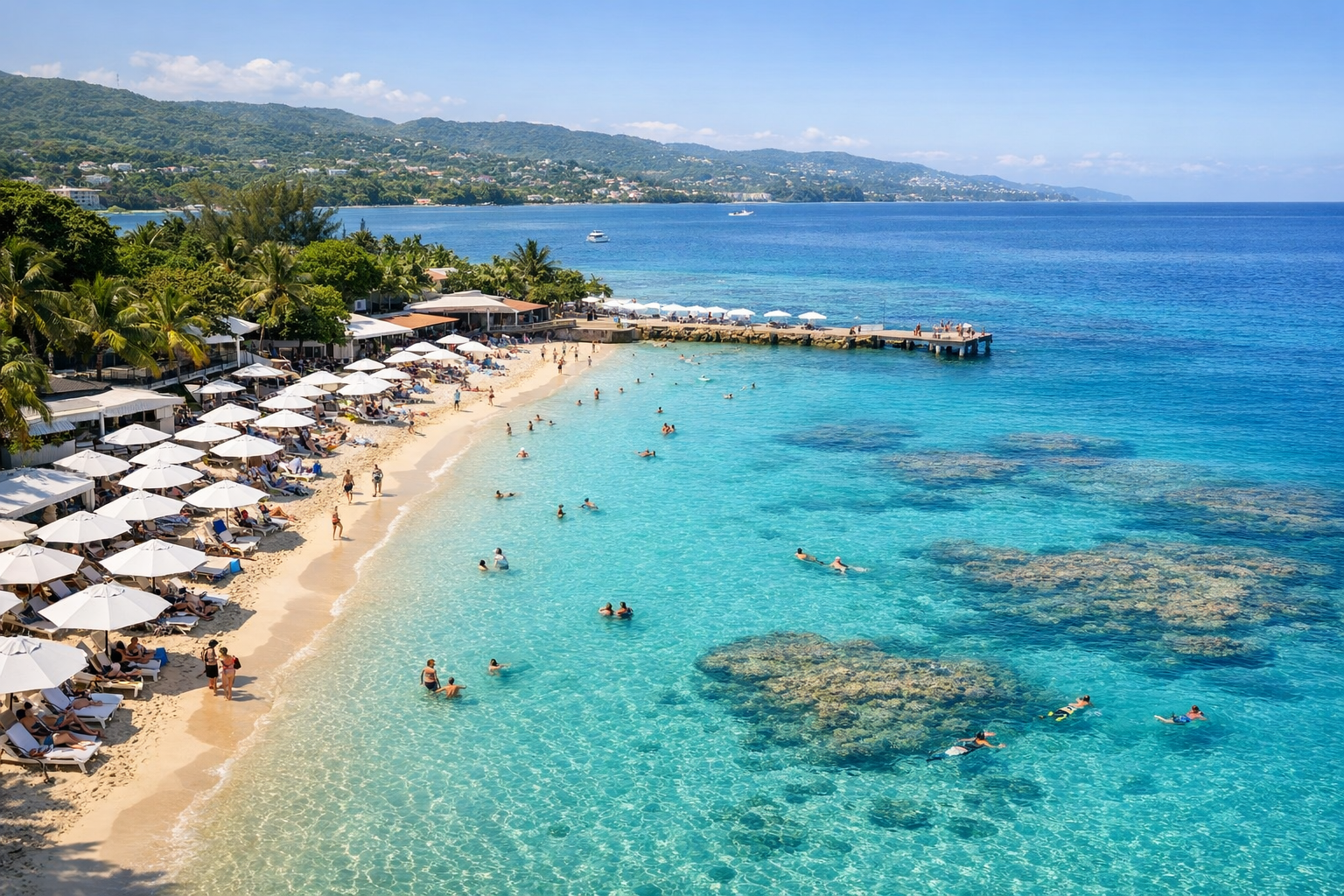
Montego Bay—universally shortened to MoBay—is Jamaica's second-largest city with a population of roughly 200,000 and its undisputed tourism capital. It sits 15–20 minutes from Sangster International Airport, which is a genuine logistical advantage: if a flight is delayed or a schedule changes, you are never far from your bed.
The destination splits naturally into two zones. The Hip Strip (Gloucester Avenue) is the traditional tourist corridor: beach bars, craft markets, restaurants ranging from tourist-targeted to genuinely excellent, and the famous Doctor's Cave Beach. Entry to Doctor's Cave runs USD $6–$8 per adult, with lounge chairs available for an additional $5–$8—a small price for what is genuinely one of the clearest public beaches in the Caribbean. The Rose Hall corridor to the east of the airport is the upscale all-inclusive zone, quieter and more manicured, anchored by properties like Half Moon, Hyatt Zilara Rose Hall, and Sandals Montego Bay.
Top Experiences in Montego Bay Rose Hall Great House offers something no beach bar can replicate: a window into Jamaica's colonial plantation history. Day tours cost USD $25–$35 per adult; the night ghost tour (USD $35–$45) built around the legend of Annie Palmer, the so-called White Witch, operates on select evenings and books out weeks ahead. Scotchies restaurant—jerk chicken and pork slow-cooked over pimento wood pits—is a non-negotiable meal for any visitor, with plates running USD $8–$15. The Luminous Lagoon at Falmouth, 45 minutes east, produces bioluminescent water on moonless nights that genuinely has to be seen to be believed; boat tours run USD $20–$30 per person. Chukka Caribbean Adventures operates zip-line, ATV, and horseback riding packages from the MoBay area, with individual activity pricing between USD $79 and $119.
What It Costs in Montego Bay Budget accommodation at guesthouses like El Greco Resort or Altamont West runs USD $80–$130 per night. Mid-range all-inclusive options such as Hotel Riu Montego Bay and Iberostar Rose Hall Beach fall in the USD $150–$320 per night range, inclusive of meals and most drinks. At the luxury end, Half Moon's private villa inventory starts around USD $600 per night and climbs significantly; Round Hill Hotel and Villas—a historic property that has hosted Winston Churchill and Paul McCartney among others—runs USD $450–$2,500 per night depending on room category. All-inclusive daily costs for a mid-range traveller settle around USD $150–$250 all-in; a budget independent traveller eating local food and using shared taxis can manage on USD $60–$100 per day.
Montego Bay makes the most sense for first-time Jamaica visitors, families who benefit from the resort infrastructure, travellers combining Jamaica with a cruise itinerary, and anyone who wants the widest range of dining and nightlife options outside the resort fence.
Negril: The Caribbean's Most Laid-Back Beach Town
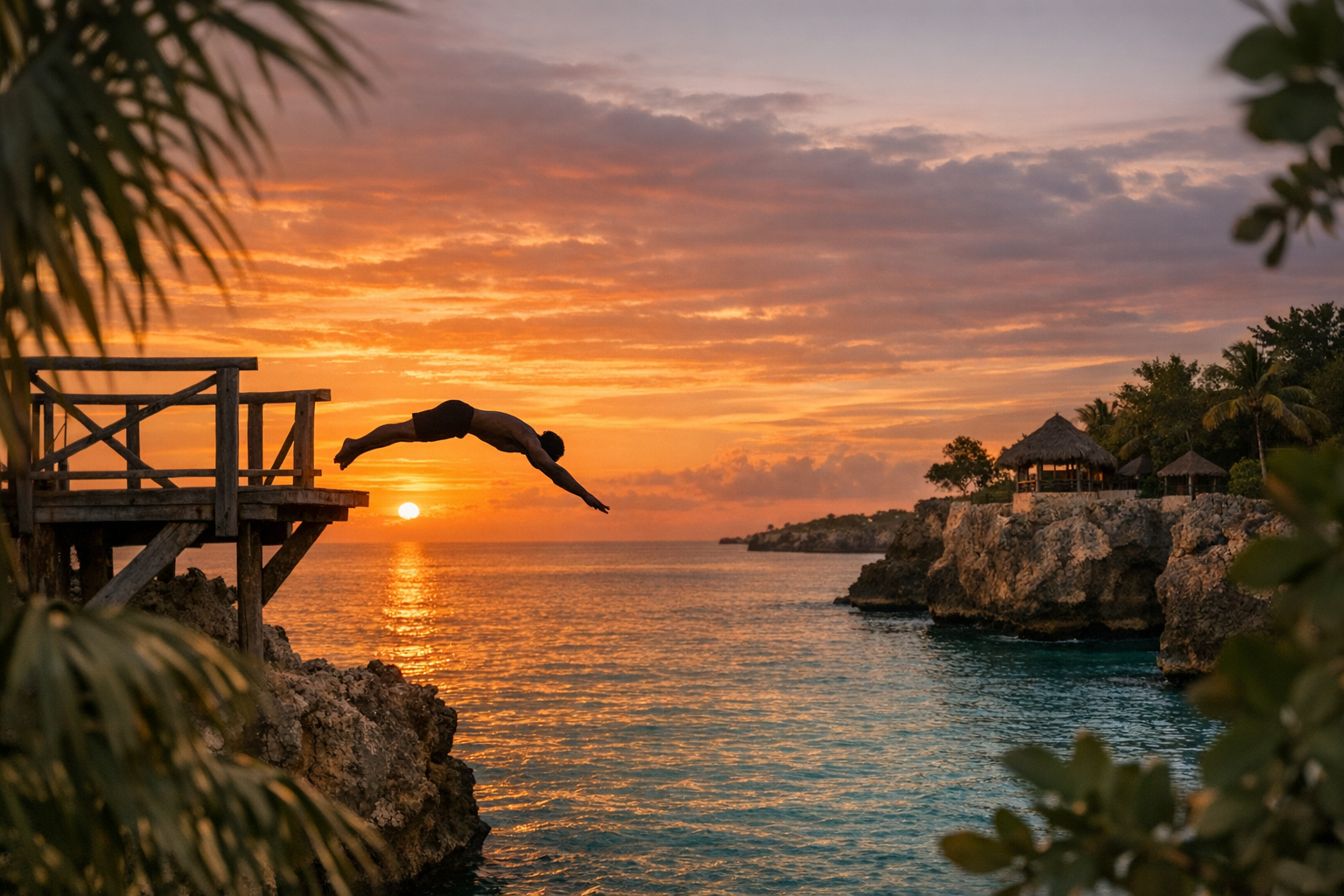
Negril sits at the westernmost point of Jamaica, roughly 90 kilometres (56 miles) and 1.5–2 hours by road from Montego Bay. There is no airport, no cruise ship terminal, and deliberately little in the way of corporate tourism infrastructure—and that is precisely the point. With a permanent population of around 10,000 people, Negril operates at a pace that is genuinely unhurried in a way that resort brochures promise but rarely deliver.
The destination divides into two distinct experiences. Seven-Mile Beach (Norman Manley Boulevard side) is the sandy stretch that earned Negril its reputation—though in reality it measures closer to seven kilometres than seven miles, it remains one of the finest continuous sand beaches in the entire Caribbean. The water is calm, warm, and clear, and beach chair rentals run USD $5–$10 per day from vendors (free if you are staying beachfront). The West End and its dramatic limestone cliffs provide the contrasting experience: no sand, but jaw-dropping sunset views, boutique cliff-side hotels, and Rick's Café.
Rick's Café & the West End Cliffs Rick's Café is one of those rare tourist attractions that lives up to its legend. The USD $10–$15 entry fee is applied toward food and drinks; local divers perform cliff jumps from 35–40 feet for tips. Arrive by 4 p.m. to secure a decent vantage point for the sunset—the west-facing cliffs catch the full spectacle as the sun drops into the Caribbean Sea, and the atmosphere between 5 and 6 p.m. is genuinely electric. Average drink prices run USD $8–$12; dinner reservations are worth making in advance if you want a seated table rather than a standing spot at the rail.
Other Negril Highlights Booby Cay Island, a small uninhabited island roughly 400 metres offshore from the south end of Seven-Mile Beach, offers excellent snorkelling over healthy coral. Boat taxis to the island cost USD $20–$40 per person. The Royal Palm Reserve provides a quieter natural counterpoint to beach life: a protected ecological area of mangroves and royal palms with guided birdwatching tours (USD $15–$25). Negril Lighthouse, built in 1894 and still functioning, marks the island's westernmost point and is free to visit on weekday mornings.
What It Costs in Negril Negril spans a wider budget range than most visitors expect. Boutique cliff-side guesthouses on the West End run USD $60–$120 per night. Mid-range beachfront hotels on Seven-Mile Beach average USD $150–$280 per night. All-inclusive options at the higher end, such as Sandals Negril and Couples Negril, run USD $350–$600+ per couple per night. For independent travellers eating at beach shacks and using shared taxis, daily costs can be held to USD $50–$80, making Negril one of the more genuinely budget-accessible destinations on the island. One caveat: beach vendors in Negril are more persistent than in MoBay or Ocho Rios; a polite but firm refusal and willingness to walk away are the standard operating procedure.
Plan this trip
Hotels in Planning & Tips
Top-rated hotels with free cancellation. Best price guaranteed.
Search Hotels →Compare Car Rentals
Compare 500+ suppliers — Hertz, Enterprise, Sixt & more.
Find Cars →Hotels in Planning & Tips
Top-rated hotels with free cancellation. Best price guaranteed.
Search Hotels →Vacation Rentals
Entire homes and condos — more space, more privacy.
Browse Rentals →Ocho Rios: Adventure Tourism & the Waterfall Capital of Jamaica
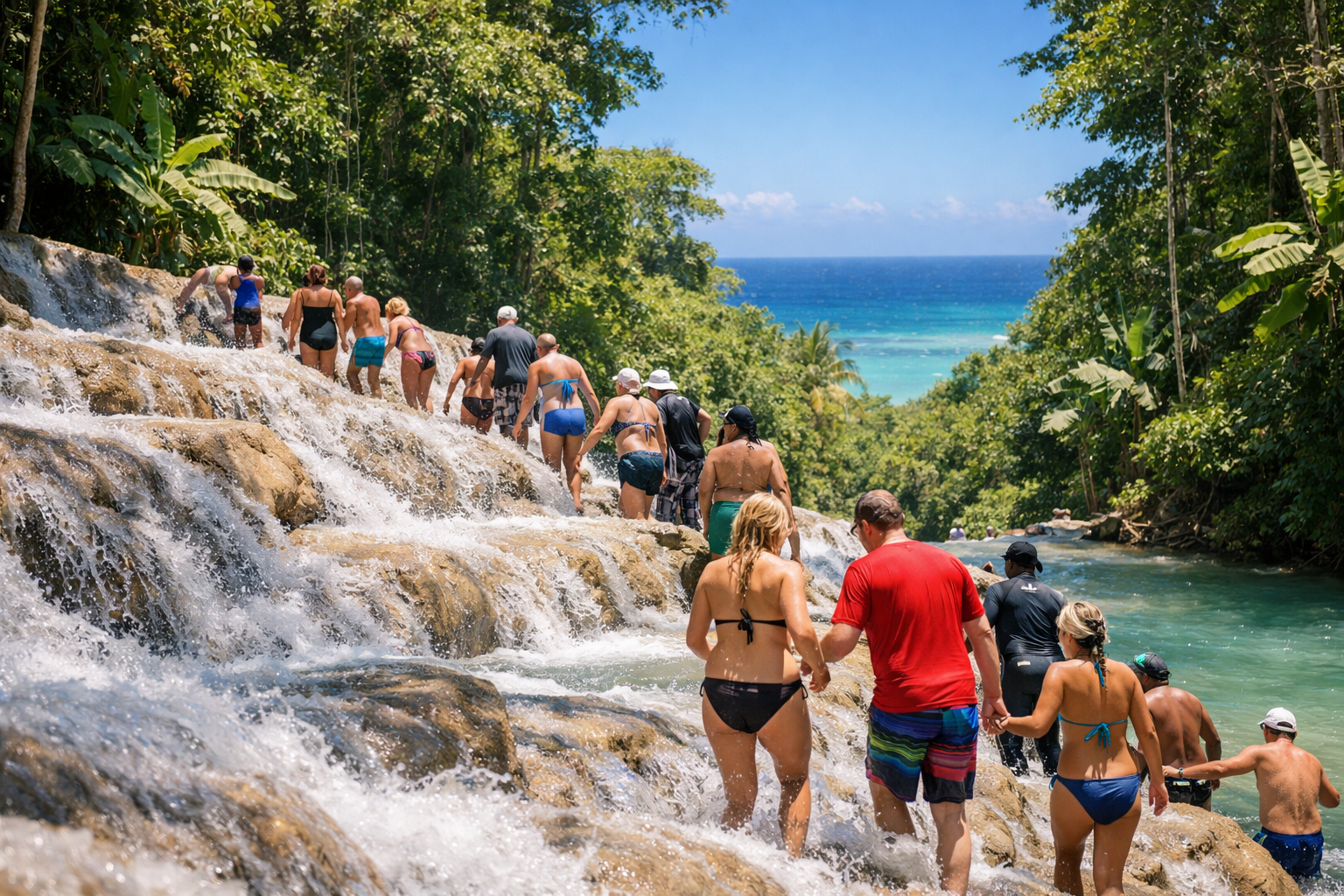
Ocho Rios (universally called Ochi by locals) sits on Jamaica's north coast approximately 107 kilometres (67 miles) and 1.5–2 hours east of Montego Bay along the A1/A3 highway. With a population of around 16,000, it is the smallest of the three main resort towns, yet it absorbs an enormous volume of visitors—the majority arriving on cruise ships, of which it receives more than any other Jamaican port.
The defining character of Ocho Rios is active tourism. Where Negril is about the beach and Montego Bay about variety, Ocho Rios trades on waterfalls, adventure excursions, and natural spectacle. The famous Dunn's River Falls—a 55-metre (180-foot) natural terraced waterfall flowing directly to a beach on the Caribbean Sea—is the single most-visited attraction in Jamaica. Tourists climb the falls in human chains guided by park staff; the experience costs USD $20–$30 per adult to enter (USD $12–$15 for children). Morning visits before the cruise ship crowds disembark—typically by 9 a.m.—are significantly more enjoyable.
Beyond Dunn's River MySTIC Mountain (Rainforest Adventures Jamaica) delivers a bobsled ride through the rainforest canopy, a zip-line over the treetops, and a sky explorer gondola with panoramic views of the coast. Combination packages run USD $60–$120 per person. Dolphin Cove, adjacent to Dunn's River, offers structured dolphin swim experiences at USD $80–$130 per person and a range of other marine animal encounters. James Bond Beach at Oracabessa, approximately 20 kilometres east of Ocho Rios, was used in filming scenes for the 1962 Bond film Dr. No and now operates as a public beach with entry at USD $5–$8. Konoko Falls and Park offers a less crowded alternative to Dunn's River with cultural exhibits and a smaller waterfall attraction (USD $15–$20 entry).
Dining & Accommodation in Ocho Rios The dining scene in Ochi is notably more limited than Montego Bay but improving. Toscanini's is the established fine-dining option for Italian-Caribbean fusion at around USD $35–$55 per person. Passage to India stands out as an unlikely but well-reviewed Indian restaurant. For Jamaican cooking, Miss T's Kitchen serves authentic local dishes at USD $10–$20 per plate and is frequently cited by food-focused travellers as the best local option in town.
Accommodation skews all-inclusive: Sandals Ochi (USD $400–$700 per couple per night), Couples Tower Isle (USD $280–$500), and Moon Palace Jamaica (USD $250–$450) represent the major resort options. The cruise-ship dynamic means that Ocho Rios empties out noticeably in the early evening once ships sail, creating a quieter atmosphere after 5 p.m. that some travellers appreciate and others find underwhelming. Ocho Rios makes the most sense for adventure-oriented travellers, families with teenagers who want active itineraries, and those who find the Montego Bay commercial strip too busy.
Side-by-Side Comparison: Which Jamaica Destination Is Right for You?
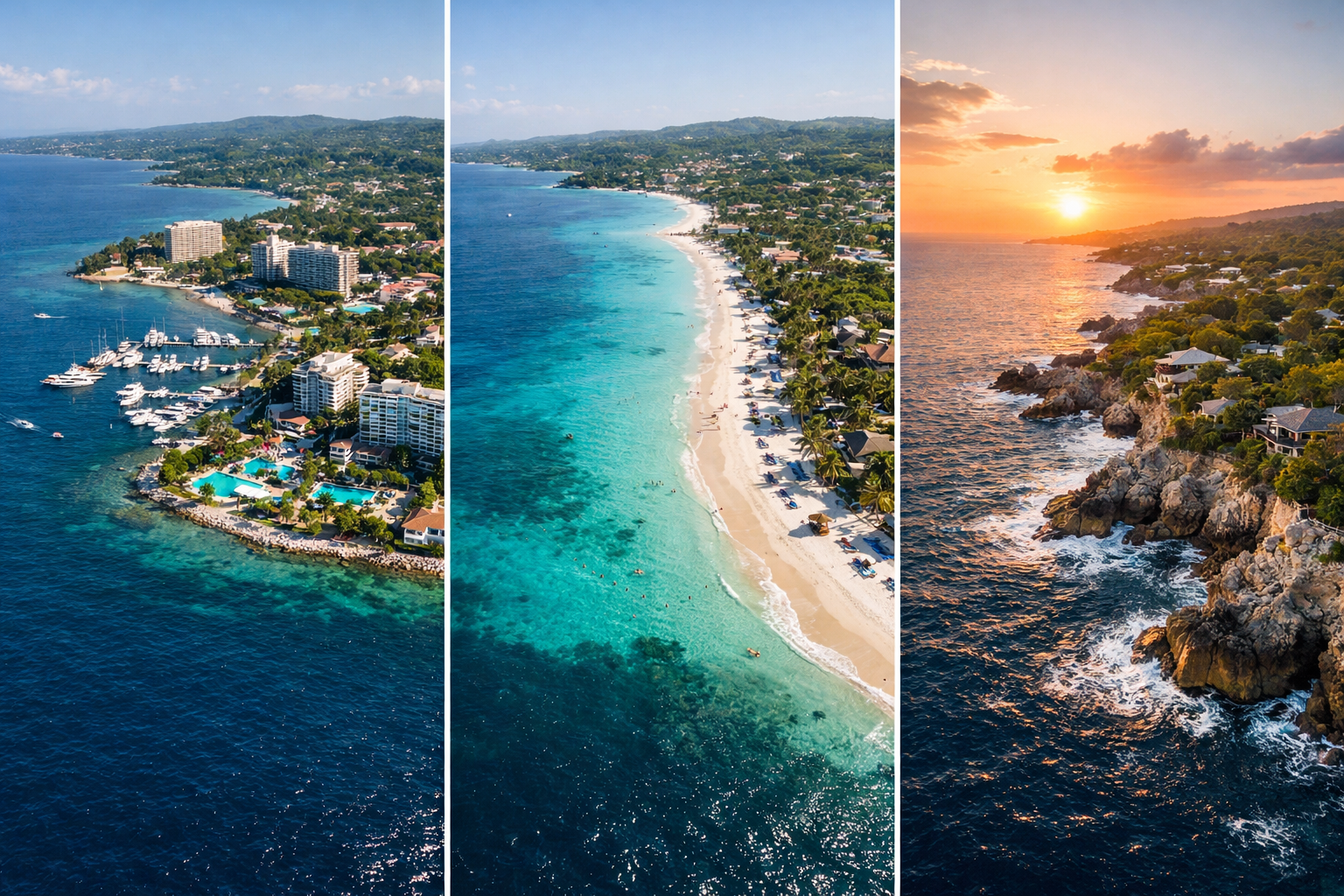
After reviewing the distinct character of each resort area, the decision ultimately comes down to five factors: what you want to do each day, who you are travelling with, your budget, how much you value proximity to the airport, and whether you want an all-inclusive package or independent flexibility.
Choose Montego Bay if: You are visiting Jamaica for the first time. You are travelling with children or mixed-age family groups. You want the widest choice of restaurants, bars, and nightlife outside the resort. You value being 15–20 minutes from the airport—particularly relevant if you have an early morning departure or a connection to catch. You are combining Jamaica with a cruise.
Choose Negril if: You want an authentically laid-back beach experience and are not in search of manufactured resort entertainment. You are a couple or solo traveller comfortable with a more independent style of travel. The West End cliff sunset experience is genuinely high on your list. You are on a tighter budget and plan to self-cater or eat locally. You have four or more nights so the 1.5–2 hour transfer from the airport does not dominate your schedule.
Choose Ocho Rios if: Adventure tourism—waterfalls, zip-lines, bobsleds, dolphin encounters—is the primary draw. You prefer a smaller-town atmosphere. You are comfortable with the all-inclusive model and are choosing Sandals Ochi or Couples Tower Isle specifically. You plan to travel east along the north coast toward Port Antonio or the Blue Mountains.
Multi-Destination Strategy Given that Montego Bay to Negril is a 90-kilometre drive and Montego Bay to Ocho Rios is 107 kilometres, a trip of ten days or more can reasonably base in Montego Bay for the first half and relocate to either Negril or Ocho Rios for the second. The Knutsford Express makes this feasible without a rental car at USD $20–$28 per leg. For travellers renting a vehicle, the full Negril-to-Ocho Rios scenic coastal route (196 kilometres, approximately 3–4 hours) is an outstanding road trip with stops at YS Falls and Black River Great Morass along the south coast.
Whatever combination you choose, pre-booking your inter-destination transfers in advance rather than arranging them on arrival invariably produces better pricing and less stress. Our overview of [travel planning resources for the Caribbean](/caribbean-travel-planning/) provides additional guidance on sequencing a multi-stop itinerary.
Plan this trip
Hotels in Planning & Tips
Top-rated hotels with free cancellation. Best price guaranteed.
Search Hotels →Compare Car Rentals
Compare 500+ suppliers — Hertz, Enterprise, Sixt & more.
Find Cars →Hotels in Planning & Tips
Top-rated hotels with free cancellation. Best price guaranteed.
Search Hotels →Vacation Rentals
Entire homes and condos — more space, more privacy.
Browse Rentals →Jamaica Travel Budget: What Things Actually Cost in 2026
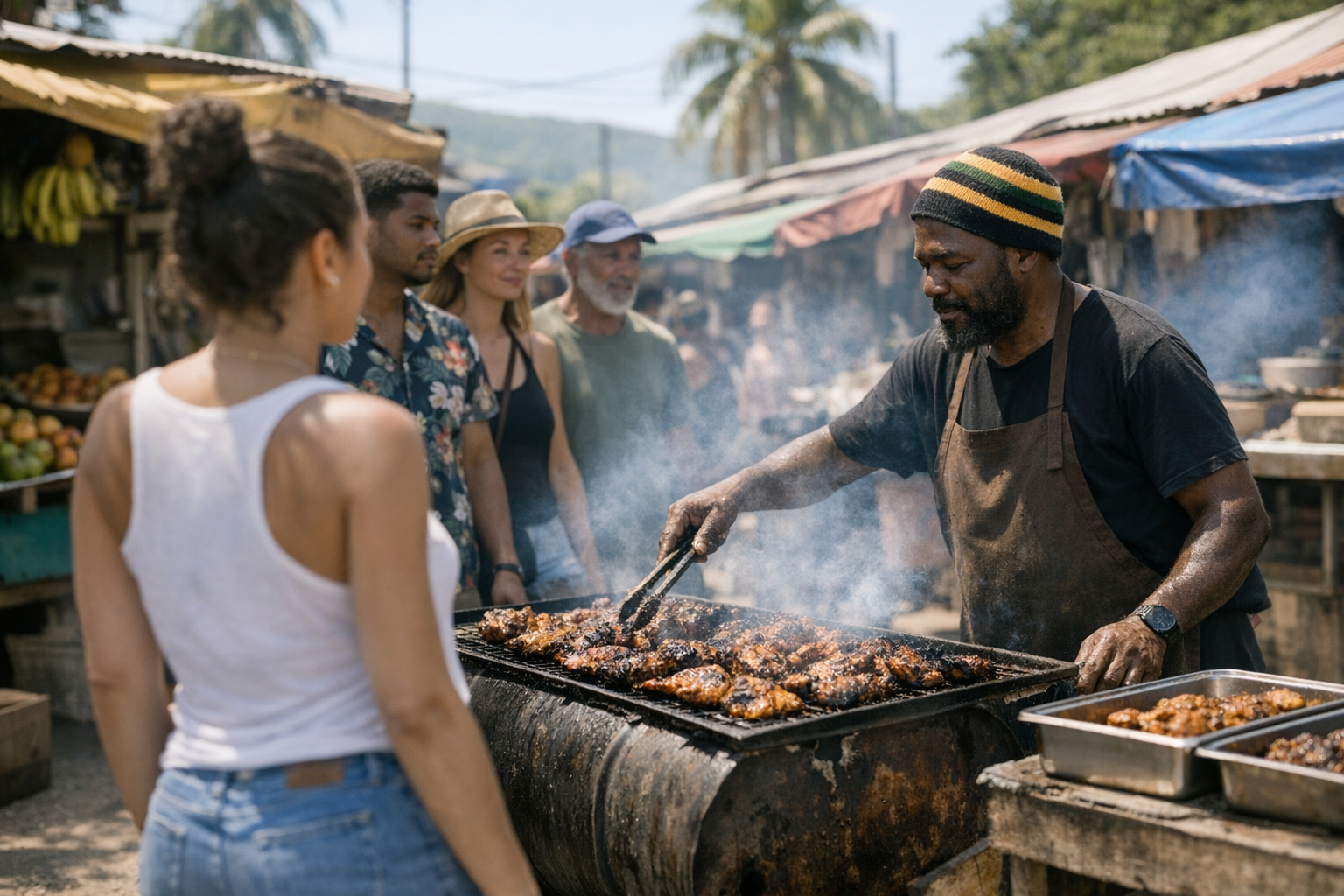
One of the most common planning mistakes for first-time Jamaica visitors is either significantly overestimating costs (assuming everything is luxury-resort priced) or underestimating them (assuming the Caribbean equals budget travel). The reality is layered.
Daily Budget Tiers (per person, not counting accommodation) - Budget traveller using guesthouses, local restaurants, and shared transport: USD $40–$70 per day - Mid-range traveller in a hotel, mix of restaurants, occasional tour: USD $100–$180 per day - All-inclusive resort: USD $200–$500 per day (meals, drinks, non-motorized watersports included) - Luxury/villa: USD $500–$1,500+ per day
Food & Drink Benchmarks Jerk chicken at Scotchies in Montego Bay: USD $8–$15. A full seafood dinner at a mid-range restaurant on the Hip Strip: USD $20–$35 per person. A Red Stripe beer at a beach bar: USD $3–$5. A rum punch: USD $7–$10 at tourist venues; USD $4–$6 at local bars. Jerk chicken from a roadside pit: USD $4–$7. An all-inclusive cocktail at your resort: effectively free within the package.
Attraction Costs Snapshot - Doctor's Cave Beach entry (Montego Bay): USD $6–$8 - Rose Hall Great House night tour: USD $35–$45 - Dunn's River Falls entry (Ocho Rios): USD $20–$30 - Rick's Café entry (Negril, applied to drinks): USD $10–$15 - Mystic Mountain Rainforest Adventure combo (Ocho Rios): USD $60–$120 - Luminous Lagoon boat tour (Falmouth): USD $20–$30 - Chukka zip-line (Montego Bay area): USD $79–$99
Currency Notes The Jamaican dollar (JMD) fluctuates against the USD; the exchange rate in early 2025 sat around JMD 155–160 per USD $1. Tourist-facing prices—hotels, tours, taxis, most restaurants—are consistently quoted in USD, and USD is widely accepted in resort areas. Change is typically given in JMD. ATMs dispensing JMD are available at the airport and in all three resort towns. Avoid exchanging money at airport arrival hall booths, which offer substantially worse rates than in-town ATMs.
For a detailed breakdown of planning your Caribbean trip budget and managing currency logistics, see our [comprehensive travel planning checklist](/travel-planning-checklist/).
Frequently Asked Questions
No. U.S., Canadian, UK, and EU citizens do not require a visa for stays of up to 90 days. However, all visitors must complete Jamaica's digital Immigration and Customs Authorization (ICA) form online at travelauthorization.mygov.jm before departure. The form is free and takes approximately five to ten minutes to complete.
For all three major resort destinations—Montego Bay, Negril, and Ocho Rios—fly into Sangster International Airport (MBJ) in Montego Bay. It is Jamaica's busiest airport with direct service from all major U.S. hubs, Toronto, and London. Norman Manley International Airport (KIN) in Kingston serves primarily domestic and business travellers and is not convenient for resort areas.
Montego Bay is generally the best choice for families, primarily because of its proximity to the airport, the widest range of all-inclusive resorts with kids' clubs, and attractions like Doctor's Cave Beach and Chukka Caribbean Adventures. Ocho Rios is strong for families with teenagers who want active experiences such as Dunn's River Falls and Mystic Mountain. Negril is better suited to couples and independent travellers.
Mid-December through April is peak season with the best weather (dry, low humidity, 24–28°C), though hotel rates run 30–60% higher than the rest of the year. May, June, and November offer excellent value with mostly good weather and 15–25% lower prices. July through October is hurricane season with higher humidity and more frequent rain, but prices drop 30–50% and resorts are far less crowded.
The main options are: (1) a private transfer for approximately USD $80–$120 for the whole vehicle (1.5–2 hours); (2) Knutsford Express air-conditioned coach at USD $20–$25 per person, bookable online at knutsfordexpress.com; or (3) a shared route taxi for USD $5–$8, though this option is slower and less practical with significant luggage.
Yes, renting a car is a viable option and provides the most flexibility, particularly for multi-destination itineraries. Remember that Jamaicans drive on the left side of the road (same as the UK). Main highways between resort towns are in reasonable condition; rural secondary roads can be heavily potholed. Economy car rentals from MBJ start at around USD $40–$80 per day. An International Driving Permit is recommended.
For most travellers, yes. All-inclusive resorts in Jamaica typically cover all meals, unlimited branded alcohol, non-motorized watersports, and entertainment. When you factor in the cost of meals (USD $20–$35 per restaurant visit), drinks (USD $7–$12 each at tourist venues), and activities, a mid-range all-inclusive running USD $200–$350 per person per day often delivers equivalent or better value compared to paying for everything à la carte. The key is choosing a resort that matches your activity preferences rather than simply picking on price.
Negril to Ocho Rios is approximately 196 kilometres (122 miles) by road—a journey of 3–4 hours depending on traffic and the route taken. There is no quick shortcut between the two destinations, which is why most travellers who want to visit both either base themselves in Montego Bay (roughly equidistant between the two) or allocate at least two separate overnight stays.
The Luminous Lagoon at Falmouth is a bioluminescent body of water approximately 45 minutes east of Montego Bay. Microorganisms in the water emit a blue-green glow when disturbed, creating a spectacular effect best seen on moonless nights. Night boat tours cost USD $20–$30 per person. It is widely regarded as one of the world's best bioluminescent sites and is absolutely worth the short drive from Montego Bay, particularly on nights with no moon.
Plan this trip
Hotels in Planning & Tips
Top-rated hotels with free cancellation. Best price guaranteed.
Search Hotels →Compare Car Rentals
Compare 500+ suppliers — Hertz, Enterprise, Sixt & more.
Find Cars →Hotels in Planning & Tips
Top-rated hotels with free cancellation. Best price guaranteed.
Search Hotels →Vacation Rentals
Entire homes and condos — more space, more privacy.
Browse Rentals →