

Why Most Travelers Spend Too Much Before They Leave Home

Every seasoned traveler has a version of the same story: you see a stunning Instagram reel of Santorini at sunset, click through to a booking site within minutes, and hand over your credit card before you've asked a single practical question. It feels decisive. It feels exciting. And according to pricing behavior data from major booking platforms, it costs you — on average — 20 to 35 percent more than travelers who take a deliberate planning-first approach.
The mistake isn't enthusiasm. The mistake is conflating two fundamentally different activities: trip planning and trip booking. These are not the same process. They are not interchangeable steps in a single workflow. They are sequential phases with distinct tools, distinct goals, and entirely different financial consequences depending on the order in which you execute them.
Trip planning is the research, strategy, and decision-making phase. No money changes hands. You're choosing destinations, defining date flexibility, mapping routing logic, researching visa requirements, checking health advisories, and comparing transportation modes. Trip booking is the transaction execution phase — purchasing flights, reserving accommodations, locking in tours and transfers, and managing cancellation policies. The moment you skip phase one and jump directly to phase two, you are operating blind. And the travel industry, with its dynamic pricing algorithms and urgency-inducing interfaces, is specifically engineered to profit from that blindness.
This guide breaks down exactly where the money goes when planning is skipped, provides verifiable cost comparisons across real destinations, and gives you a sequenced framework for approaching your next trip the way professional travel planners do — methodically, strategically, and with measurable savings.
The Flight Pricing Window: What the Data Actually Shows

Flight prices are not random. They follow documented behavioral patterns tied to booking lead time, day of week, and seat inventory. Understanding these patterns is the single highest-return research investment you can make in the planning phase — before you open a single booking tab.
For domestic US flights, Hopper's 2024–2025 data consistently identifies the optimal booking window as one to three months before departure. Tickets purchased within two weeks of travel average $50 to $150 more per ticket than those booked in that sweet spot. For international routes, the window extends to two to six months out, and the stakes are considerably higher. Booking 21 or more days in advance versus within the last seven days yields fares that are, on average, 30 to 40 percent cheaper.
To put real numbers on that: a round-trip from New York's JFK to Paris Charles de Gaulle, booked three months in advance in 2025, runs approximately $450 to $650 per person. The same route booked one week before departure routinely costs $900 to $1,400. Los Angeles to Tokyo, purchased four months out, averages $600 to $850; last-minute, that figure climbs to $1,200 to $2,000 or more. Chicago to Cancún — booked six to eight weeks ahead at $280 to $400, versus $500 to $750 in the final two weeks.
Day of week matters too. Tuesday, Wednesday, and Saturday departures are consistently the cheapest. Friday and Sunday are the most expensive, driven by business and leisure demand respectively. Planning phase work means identifying these patterns before committing to specific travel dates.
The tools that belong in your planning phase are distinct from booking platforms. Google Flights' Explore map lets you visualize the cheapest destinations reachable from your home airport without committing to anything. Skyscanner's free Price Alert tool notifies you when fares drop on specific routes. Hopper's Price Freeze feature — costing $5 to $21 — lets you lock a fare for seven to fourteen days while you continue planning the rest of your trip. Google Flights' Price Guarantee, expanded in 2024, refunds the difference if a fare drops after booking through Google directly. These are planning tools masquerading as booking tools, and knowing how to use them in sequence is what separates a $650 transatlantic ticket from a $1,300 one.
Accommodation: Where the Planning Advantage Compounds

The conventional wisdom that last-minute hotel deals are always available is outdated and destination-dependent. For popular destinations during peak periods, it is demonstrably false. For shoulder-season travel to less-trafficked cities, it may occasionally hold. Planning lets you know which scenario applies — impulse booking forces you to gamble.
Hotels price their non-refundable advance purchase rates 10 to 25 percent below flexible rates. That discount is only rational to capture if you have a confirmed plan. Booking a non-refundable rate on an impulse — before you've verified dates, routing, and visa eligibility — risks paying cancellation penalties that wipe out the discount entirely. Marriott and Hilton advance purchase rates run up to 30 percent below rack rate when booked 30 to 60 days out. Booking.com's Genius discount tier, which requires account history and advance browsing behavior, is simply unavailable to a first-time impulse booker.
Real cost comparisons from summer 2025 illustrate the stakes. A three-star hotel near the Colosseum in Rome: booked three months in advance at roughly €95 per night; the same property two weeks out at €145 to €180. A Kyoto hotel during cherry blossom season — late March through mid-April — booked the prior September at ¥18,000 to ¥25,000 per night; the same hotel in January, when most rooms are already gone, at ¥35,000 to ¥50,000 or more. A midtown Manhattan three-star during the holiday season: $180 to $220 booked three months out; $280 to $400 booked two weeks before.
For vacation rentals on platforms like VRBO and Airbnb, early-bird discounts of 10 to 20 percent are common for stays booked 30 to 90 days ahead. Last-minute Airbnb discounts do exist within seven days, but the selection at popular destinations is what's left after the top-rated properties — which booked out six to twelve months ahead — have long since been claimed. In Santorini, Amalfi, and Bali for summer 2025, the best-reviewed properties were fully reserved before the new year.
For travelers considering vacation rentals as a flexible base for family or group travel, exploring VRBO's inventory early in the planning phase — not the booking phase — allows proper comparison of neighborhoods, amenities, and host cancellation policies before any financial commitment.
Plan this trip
Compare Car Rentals
Compare 500+ suppliers — Hertz, Enterprise, Sixt & more.
Find Cars →Vacation Rentals
Entire homes and condos — more space, more privacy.
Browse Rentals →Hotels in Trip Planning vs. Booking Understanding the Difference That
Top-rated hotels with free cancellation. Best price guaranteed.
Search Hotels →Visas, Entry Fees, and the Consequences of Not Checking First

Visa research is pure planning-phase work. There is no booking equivalent — you cannot transact your way out of a denied boarding notice at the gate. And yet, travelers who skip directly to flight and hotel bookings routinely discover entry requirements only after their itinerary is already locked and partially paid.
The 2025 entry landscape has shifted significantly, creating new catch points for underprepared travelers. The United Kingdom launched its Electronic Travel Authorisation for US citizens in January 2025 — a £10 (~$13) pre-travel requirement that must be secured before departure. Travelers who booked flights months earlier without researching entry conditions found out about the ETA only when airlines began enforcing it. The EU ETIAS — European Travel Information and Authorization System — has been delayed repeatedly and is now expected to launch mid-2025, potentially slipping to 2026. At €7 for US passport holders, it will require advance online application and will affect the tens of millions of Americans who visit EU Schengen countries annually.
Existing requirements catch travelers too. Australia's ETA costs $20 AUD and must be pre-applied for online; travelers without one can face denied boarding. India's e-Visa requires a minimum of four business days before travel and costs $25 to $100 depending on duration — same-day processing is not available at any price. Machu Picchu now operates on strict daily visitor caps with entry organized by circuit and time slot at 200 Peruvian soles (~$54 USD); the Inca Trail requires permits booked five to six months in advance. New Zealand's NZeTA remains required at approximately $10 USD, and Sri Lanka reinstated its e-Visa requirement at $20 for a 30-day stay.
The financial consequence of missing these requirements is significant. Emergency same-day visa expediting services charge $150 to $500. Missing a non-refundable flight because of a denied boarding situation means losing that fare entirely. Travel insurance purchased within 14 to 21 days of the first trip deposit — a planning-phase decision — can cover trip cancellation for covered reasons. Travel insurance purchased after the fact or not at all leaves you absorbing the full loss.
The CDC Traveler's Health website and official embassy portals are the authoritative sources for entry and health requirements. VisaHQ and iVisa are useful aggregators for requirement research, though the actual applications should always be submitted through official government portals.
Routing Efficiency: The Hidden Cost of Booking Without a Map

One of the least-discussed planning benefits has nothing to do with advance pricing. It's routing logic — the geographic sequencing of attractions, accommodations, and transportation that determines whether your itinerary is efficient or expensive.
Consider Tokyo. A traveler who hasn't mapped their itinerary might take the Shinkansen from Shibuya to Nikkō and back on day three, spending ¥6,000 to ¥8,000 round-trip — and then realize they've booked a hotel near Nikkō for day six. The same trip could have been accomplished once. In Paris, a tourist who visits Versailles, returns to central Paris for the night, and then travels to Disneyland Paris separately spends €25 to €30 in unnecessary transportation compared to a traveler who clustered those outer-Paris destinations on a logical geographic arc.
The hub strategy — choosing which city to use as a base before booking any accommodation — can save $200 to $400 on an Italian itinerary by reducing unnecessary check-in and check-out nights and enabling advance purchase of rail passes. Italian high-speed trains are a perfect example of a planning-phase decision with major booking-phase consequences: Trenitalia and Italo's 'Mini' non-refundable fares on the Rome-Florence route run €19 to €29 when booked in advance through Trenitalia.com or Italotreno.it. Walk-up fares at the station for the same train cost €45 to €60. That €26 to €31 per-segment difference, multiplied across multiple legs and multiple travelers, is not a rounding error.
Rome2Rio is the planning tool for this work — a free platform that compares all transportation modes between any two points globally, complete with estimated prices and travel times. It belongs in the planning phase, used before any accommodation is booked, to establish the geographic logic that makes your itinerary both experientially coherent and cost-efficient. Pair it with Google Maps' offline download capability so the routing intelligence you develop during planning is accessible on the ground without data charges.
For travelers planning multi-city itineraries that include airport transfers and ground transportation between destinations, reviewing dedicated ground transportation options early in the planning phase — before locking in hotel locations — can substantially reduce the total cost of getting around.
Plan this trip
Compare Car Rentals
Compare 500+ suppliers — Hertz, Enterprise, Sixt & more.
Find Cars →Vacation Rentals
Entire homes and condos — more space, more privacy.
Browse Rentals →Hotels in Trip Planning vs. Booking Understanding the Difference That
Top-rated hotels with free cancellation. Best price guaranteed.
Search Hotels →Attractions That Sell Out Months in Advance — and the Passes Worth Buying

In 2025, showing up to a world-famous attraction without a reservation is no longer a matter of a longer queue. For a growing list of sites, it means not getting in at all.
The Colosseum in Rome requires timed-entry booking in advance through coopculture.it at €18 per adult; summer slots sell out weeks ahead and walk-up tickets are extremely limited. The Uffizi Gallery in Florence requires timed-entry reservations during peak season at €25 per adult — available at uffizi.it. The Sagrada Família in Barcelona, priced at €26 to €36 depending on access level, books out months ahead through the official sagradafamilia.org portal. The Anne Frank House in Amsterdam is entirely reservation-only at €16 per person and frequently sells out two to four weeks in advance through annefrank.org. Vatican Museums offer timed slots at €20 base admission; booking in advance eliminates two to three hour queues. The Acropolis in Athens at €20 standard ticket fills its timed-entry slots in summer.
Beyond Europe, Machu Picchu's strict daily visitor caps require advance booking by circuit and time slot. Arizona's The Wave — limited to 64 visitors per day — operates on a lottery system with the online lottery opening four months ahead of the date. Antelope Canyon requires booking through authorized Navajo Nation tour operators at $80 to $160 per person, with peak times selling out weeks in advance.
City passes require planning to deliver value. The Paris Museum Pass at €52 for two days, €66 for four days, and €78 for six days covers more than 50 sites — but only beats per-entry pricing if you've mapped which museums you'll actually visit and confirmed their hours and closures. The Rome Pass at €38.50 for 48 hours or €52 for 72 hours includes public transport and museum discounts — worth purchasing only after itinerary planning confirms the value. Go City passes, available for 30-plus destinations at $50 to $200 per person, require the same pre-purchase itinerary analysis to determine breakeven.
The planning phase is when you make this analysis. The booking phase is when you act on it. Conflating the two — buying a city pass on the day you arrive without having verified your itinerary — is one of the most common ways well-intentioned travelers waste $50 to $150 per person on passes that don't pay out.
Travel Insurance, Currency, and the Fees That Silently Drain Budgets
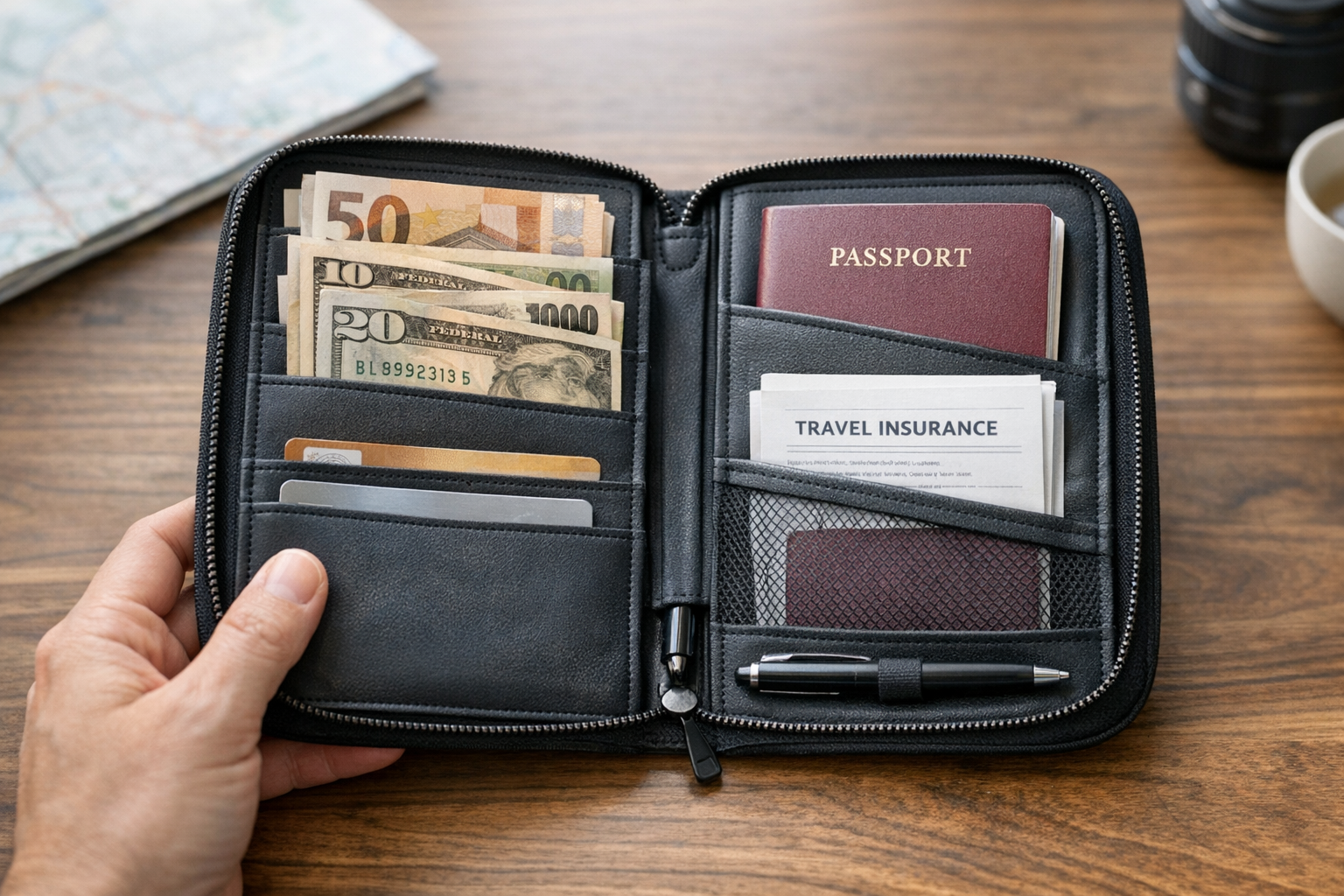
Two categories of planning-phase decisions consistently produce disproportionate savings or losses, yet receive almost no attention compared to flights and hotels: travel insurance timing and payment infrastructure.
Travel insurance is a planning-phase purchase masquerading as a booking-phase afterthought. The most comprehensive form — Cancel for Any Reason, or CFAR coverage — must typically be purchased within 14 to 21 days of your first trip deposit. CFAR policies cost 8 to 12 percent of total trip cost but refund 75 percent of expenses for any reason whatsoever. Standard trip cancellation policies run 4 to 8 percent and cover only defined reasons like illness, injury, or death. For a $5,000 trip, a standard policy costs $200 to $400; CFAR costs $400 to $600. The window to choose — and to qualify for CFAR — closes within three weeks of your first booking. Travelers who book impulsively and add insurance later have already forfeited the option.
InsureMyTrip.com and Squaremouth.com are the most comprehensive comparison tools for evaluating policies across multiple providers. Both are free to use and allow filtering by coverage type, which matters enormously when comparing policies that look similar on price but differ significantly on covered reasons and medical evacuation limits.
Payment planning produces quieter savings that accumulate trip-wide. Airport currency exchange kiosks charge spreads of 8 to 15 percent above mid-market rates — they are, without exception, the worst option available. Ordering foreign currency through your bank with one to two weeks' notice yields exchange rates 3 to 5 percent better. The Charles Schwab Bank debit card charges zero foreign transaction fees and reimburses all ATM fees worldwide — but requires opening the account before travel. The Wise card loads currency at near-mid-market rates with fees of approximately 0.35 to 2 percent in 2025, versus 3 to 5 percent for most standard bank cards.
Knowing in advance which destinations are cash-heavy — Japan and Germany remain predominantly cash-based in 2025 — allows you to arrive prepared rather than paying premium rates at the nearest airport kiosk upon landing. For travelers who fly frequently, the $85 TSA PreCheck (five-year validity) and $120 Global Entry (five-year validity, includes PreCheck) are planning investments that require three to six months of lead time for application processing — and are simply unavailable to travelers who didn't think to apply in advance.
Plan this trip
Compare Car Rentals
Compare 500+ suppliers — Hertz, Enterprise, Sixt & more.
Find Cars →Vacation Rentals
Entire homes and condos — more space, more privacy.
Browse Rentals →Hotels in Trip Planning vs. Booking Understanding the Difference That
Top-rated hotels with free cancellation. Best price guaranteed.
Search Hotels →The Complete Planning-to-Booking Timeline (International Trip Framework)

The most useful output of understanding the planning-versus-booking distinction is a sequenced timeline that tells you when to do what — not just what to do. For an international trip of ten to fourteen days with a budget of $3,000 to $6,000 per person, the following sequence reflects optimal decision-making order based on pricing windows, visa lead times, insurance eligibility windows, and attraction reservation availability.
Six or more months before departure is the pure planning phase. Destination research, budget framework, and date-flexibility analysis happen here. Passport validity must be confirmed — most countries require six months of validity beyond your travel dates, meaning a passport expiring in eight months is effectively expired for international travel. Visa requirements are researched via official embassy portals. The CDC Traveler's Health site is consulted for vaccination and health requirements. Google Flights price alerts are set but no purchases are made.
Four to five months out is when flights are booked — within the optimal pricing window for most international routes. Travel insurance is purchased within 14 to 21 days of that first flight booking to preserve CFAR eligibility. Visa applications are submitted if required, accounting for processing time.
Three to four months out is the accommodation booking window, when non-refundable advance purchase discounts are rational to capture because the plan is confirmed. High-demand attraction reservations — Colosseum, Sagrada Família, Machu Picchu permits, Anne Frank House — are secured in this window. Popular restaurants requiring advance booking are reserved now.
One to two months out covers tours, day trips, and airport transfers. This is also when to apply for travel credit cards if needed — most require four to six weeks for delivery and processing — and to notify your bank of travel dates to prevent fraud holds.
Two weeks before departure: offline maps and translation apps are downloaded, all bookings are confirmed, and entry requirements are checked for any last-minute regulatory changes (particularly relevant given the rolling implementation of new entry systems like UK ETA and EU ETIAS).
Following this sequence on a ten-day Italy trip for two people illustrates the aggregate effect. Flights booked four months out at $1,100 per person versus two weeks out at $1,800 save $1,400. Hotels across Rome, Florence, and Venice planned in advance versus booked last-minute save another €835. Advance train tickets on Trenitalia versus walk-up fares save approximately €80. Official attraction tickets versus scalper fast-track and line-skipping tour premiums save €44. Total estimated savings across the trip: $2,500 to $3,500 — for the same itinerary, the same destinations, and the same experiences.
The planning phase costs nothing but time. The booking phase is where money moves. The sequence in which you perform them determines which number appears on your final credit card statement.
Frequently Asked Questions
Trip planning is the research and decision-making phase — choosing destinations, dates, routing, and budget — during which no money is exchanged. Trip booking is the transaction phase where you purchase flights, reserve hotels, and lock in tours. Skipping planning and going directly to booking is the primary reason most travelers overspend by 20 to 35 percent on the same itinerary a deliberate planner would have executed for less.
For most international routes, the optimal booking window is two to six months before departure. Hopper's 2024–2025 data shows that booking 21 or more days out versus within the last seven days produces average savings of 30 to 40 percent per ticket. On a JFK–Paris route, that translates to roughly $250 to $750 per person in real dollar savings.
Several major attractions now require pre-booked timed-entry and sell out weeks or months ahead. These include the Colosseum in Rome, the Uffizi Gallery in Florence, the Sagrada Família in Barcelona, the Anne Frank House in Amsterdam, the Vatican Museums, Machu Picchu (where Inca Trail permits book out five to six months in advance), and Arizona's The Wave, which operates on a lottery system limited to 64 visitors per day.
Travel insurance — especially Cancel for Any Reason (CFAR) coverage — must typically be purchased within 14 to 21 days of your first trip deposit to qualify for the broadest protection. CFAR policies cost 8 to 12 percent of total trip cost and refund 75 percent of expenses for any reason. Waiting until after that window closes means forfeiting the CFAR option, leaving you with standard cancellation coverage that only applies to specific covered events.
The United Kingdom launched its Electronic Travel Authorisation (ETA) for US citizens in January 2025, costing £10 and required before boarding. The EU ETIAS is expected to launch mid-2025, requiring a €7 advance online application for US passport holders visiting Schengen countries. Australia's ETA ($20 AUD), New Zealand's NZeTA (~$10 USD), India's e-Visa ($25–$100, minimum four business days processing), and Sri Lanka's reinstated e-Visa ($20 for 30 days) remain in effect. Researching these requirements in the planning phase prevents denied boarding and expensive last-minute expediting fees.
Airport currency kiosks charge spreads of 8 to 15 percent above mid-market rates and should always be your last resort. Ordering currency through your bank one to two weeks before travel yields rates 3 to 5 percent better. The Charles Schwab Bank debit card charges zero foreign transaction fees and reimburses all ATM fees globally. The Wise card operates near mid-market rates with fees of approximately 0.35 to 2 percent. All of these require advance planning — none are available on the day you arrive at an airport kiosk.
City passes only deliver value when you've confirmed your itinerary in the planning phase. The Paris Museum Pass (€52 for two days, covering 50-plus sites) pays off only if you've verified which museums you'll visit and confirmed they're open. The Rome Pass (€38.50 for 48 hours) is worthwhile only if your itinerary includes sufficient qualifying sites to exceed the per-entry cost. Buying either pass on arrival without a planned itinerary is one of the most common ways travelers waste $50 to $150 per person.
Booking hotels and transportation without first mapping the geographic logic of your itinerary leads to avoidable costs. In Tokyo, a poorly planned day trip to Nikkō and back can cost ¥6,000 to ¥8,000 in train fares that could have been consolidated into a single journey. In Paris, visiting outer-city attractions on separate days adds €25 to €30 in unnecessary transport. For an Italian multi-city trip, choosing the wrong hub city can add $200 to $400 in accommodation and transit costs. The solution is using free tools like Rome2Rio to establish routing logic before booking any accommodation.
Plan this trip
Compare Car Rentals
Compare 500+ suppliers — Hertz, Enterprise, Sixt & more.
Find Cars →Vacation Rentals
Entire homes and condos — more space, more privacy.
Browse Rentals →Hotels in Trip Planning vs. Booking Understanding the Difference That
Top-rated hotels with free cancellation. Best price guaranteed.
Search Hotels →