Why 2026 Is the Year to Book Europe's Most Spectacular Train Routes
Rail travel across Europe has entered a genuine golden age. New luxury carriages, reinstated historic routes, and a continent-wide push toward sustainable tourism have conspired to make 2026 one of the most compelling years in decades to board a train and let the landscape do the talking. Whether you're lured by the glacier-draped passes of Switzerland, the plunging fjords of Norway, or the sun-drenched coastline of northern Spain, Europe's rail network delivers experiences that no aircraft or motorway can replicate.
The numbers back this up. International rail bookings through European operators rose by more than 30 percent between 2022 and 2024, driven in part by travelers seeking lower-emission alternatives to short-haul flights. But sustainability is only part of the story. These journeys are genuinely, irreducibly beautiful — the kind of slow travel that forces you to put the phone down and simply watch the world transform outside your window.
In this guide we cover seven of the most spectacular rail journeys on the continent, with verified 2026 pricing, seat-selection advice, booking lead times, and practical connections for each route. Whether you're a first-time rail traveler planning a Switzerland itinerary or a seasoned Belmond loyalist chasing the reinstated Istanbul service, you'll find everything you need to plan with confidence.
Before you depart, a quick note on logistics: pairing a great train journey with the right accommodation and ground transfers at either end transforms a good trip into a flawless one. Our guides on [luxury airport transfers](/luxury-airport-transfers/) and [private car hire for European travel](/private-car-hire-europe/) can help you plan seamless door-to-station connections at both ends of your journey.
Journey 1: Glacier Express — Switzerland's Crown Jewel
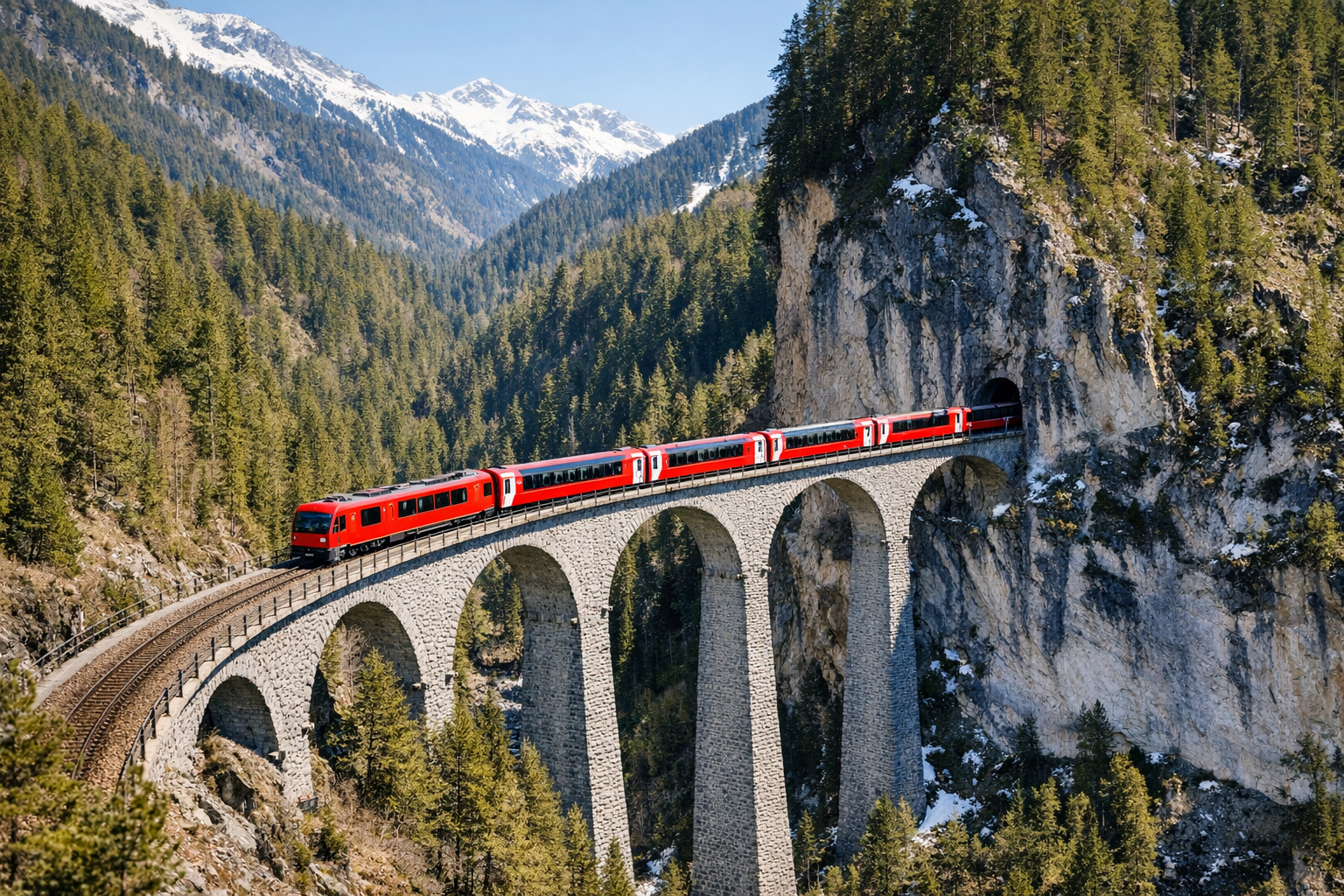
No list of Europe's most spectacular train routes is complete without the Glacier Express, and no description of it quite captures the reality. Stretching 291 kilometres from the car-free alpine village of Zermatt to the sun-polished resort of St. Moritz, this eight-hour crossing is deliberately, defiantly slow — marketed as the 'world's slowest express train' with a straightforwardness that borders on comedy. The payoff for that unhurried pace is a relentless procession of scenery: 291 bridges, 91 tunnels, and a summit at the Oberalp Pass sitting 2,033 metres above sea level.
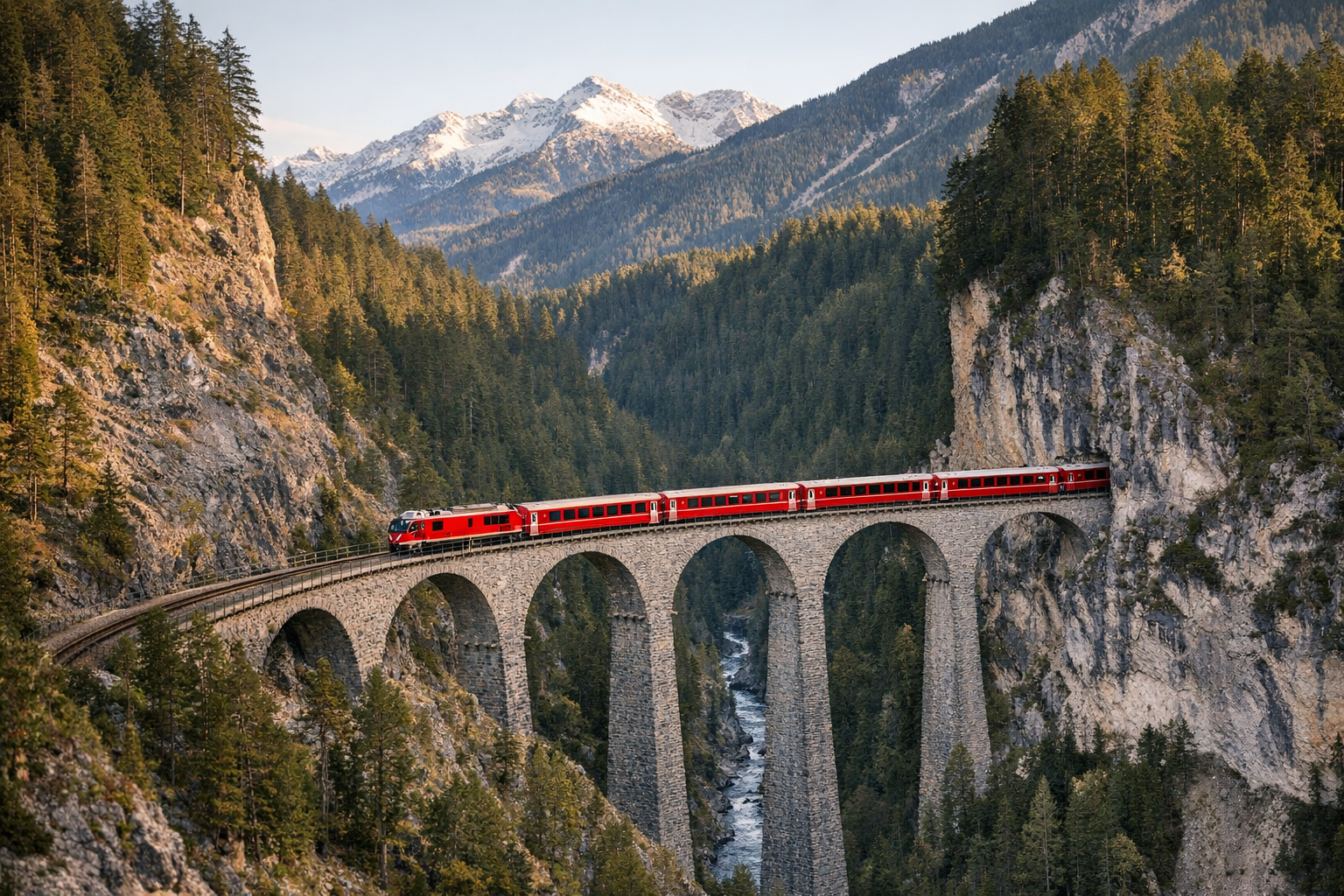
The undisputed visual centrepiece is the Landwasser Viaduct near Filisur — a 65-metre-high, 136-metre-long curved limestone bridge that sweeps directly into a tunnel carved through the rock face. UNESCO inscribed the Rhaetian Railway that operates this section as a World Heritage Site in 2008, and the viaduct is the reason why. Sit on the right side of the train travelling from Zermatt to St. Moritz and have your camera ready.
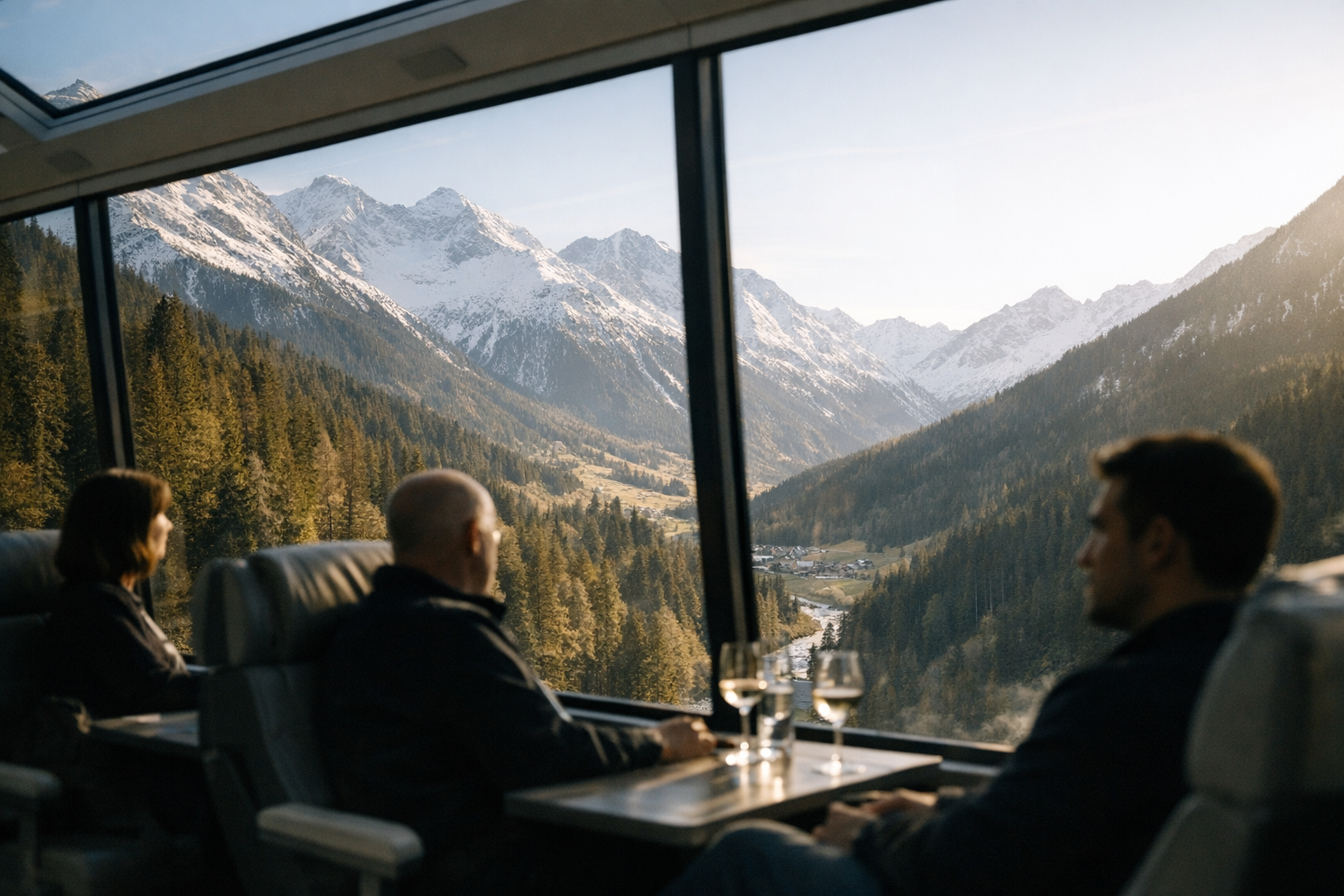
In terms of 2026 pricing, a standard second-class ticket for the full journey costs approximately CHF 153 (around €160), while first class comes to CHF 262 (around €274). Swiss Travel Pass holders pay only the mandatory reservation supplement of CHF 16–49, which makes the pass exceptional value if you're combining this with broader Swiss travel. The premium option — Excellence Class — adds a six-course gourmet meal, table-level panoramic windows, and a maximum of 36 passengers per carriage. The supplement runs to CHF 359 on top of first class, bringing the total to roughly CHF 621 (approximately €650). Reservations are mandatory for all classes and can be made through glacierexpress.ch or rail.ch.
Excellence Class operates May through October only and routinely sells out three to six months ahead of peak season. For shoulder-season travel, late May or September delivers fewer crowds, lower prices, and either spring wildflowers or autumn foliage draping the valley floors. The journey can also be broken into segments — Zermatt to Andermatt, or Chur to St. Moritz — if a full-day commitment doesn't suit your itinerary.
Journey 2: Bernina Express — From the Alps to Italy Without a Tunnel
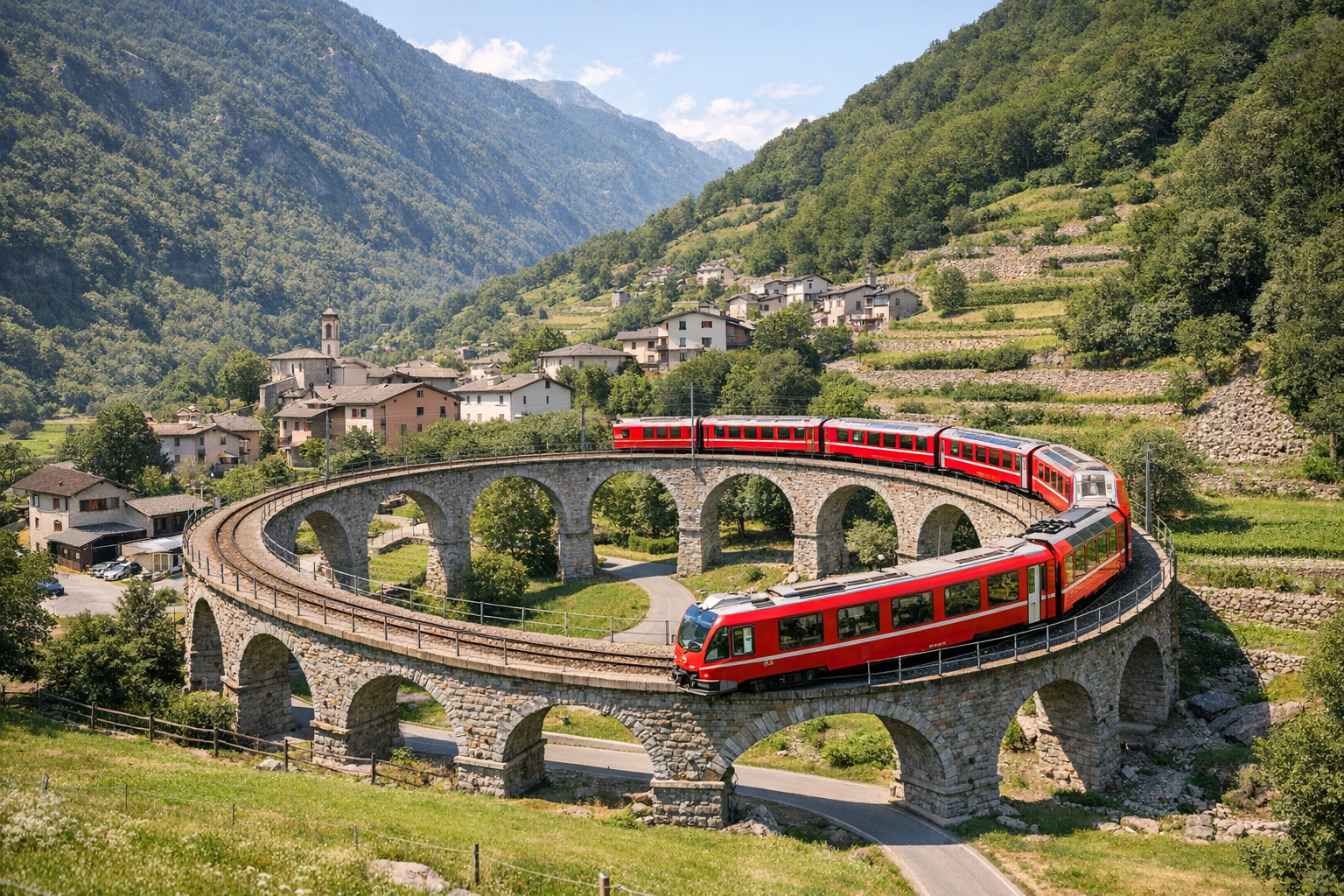
Where the Glacier Express is long and meditative, the Bernina Express is compact and almost aggressively dramatic. Covering 144 kilometres from Chur (or Davos) to Tirano in northern Italy in approximately four hours, this UNESCO-listed route achieves something genuinely rare: it crosses the highest railway pass in the Alps — Ospizio Bernina at 2,253 metres — entirely in the open air, with no tunnel to interrupt the spectacle. The surrounding landscape shifts from Swiss alpine meadows dusted with wildflowers to the glacial blue of Lago Bianco and then, within the same journey, to the olive-and-terracotta warmth of Lombardy.
The Morteratsch Glacier, one of Switzerland's longest, is visible from the train windows, a reminder that these landscapes are changing and worth seeing now. Near the Italian border, the Brusio Circular Viaduct — a nine-arch helical structure that spirals the train through 360 degrees to manage the steep descent — is an engineering spectacle that draws gasps even from repeat travellers. Sit on the left side heading from St. Moritz to Tirano for the clearest view of this extraordinary structure.
A second-class ticket for the full Chur-to-Tirano route costs approximately CHF 73 (around €77) in 2026, with first class at CHF 128. A mandatory reservation fee of CHF 14–16 applies for the panoramic carriages, and Swiss Travel Pass holders again cover the base fare with the pass. Interrail and Eurail holders receive a 50 percent discount on the base fare plus the reservation fee — one of the better deals in European rail.
From Tirano, the journey extends naturally southward. A connecting local Italian train to Colico on Lake Como takes roughly 45 minutes, where ferries serve Bellagio, Varenna, and Como itself. Alternatively, the Bernina Express Bus continues to Lugano in approximately three hours for a further CHF 35. Few rail itineraries in Europe offer such a seamless transition from alpine Switzerland to Italian lakeside culture in a single day.
Plan this trip
Journey 3: Venice Simplon-Orient-Express — The World's Most Romantic Train
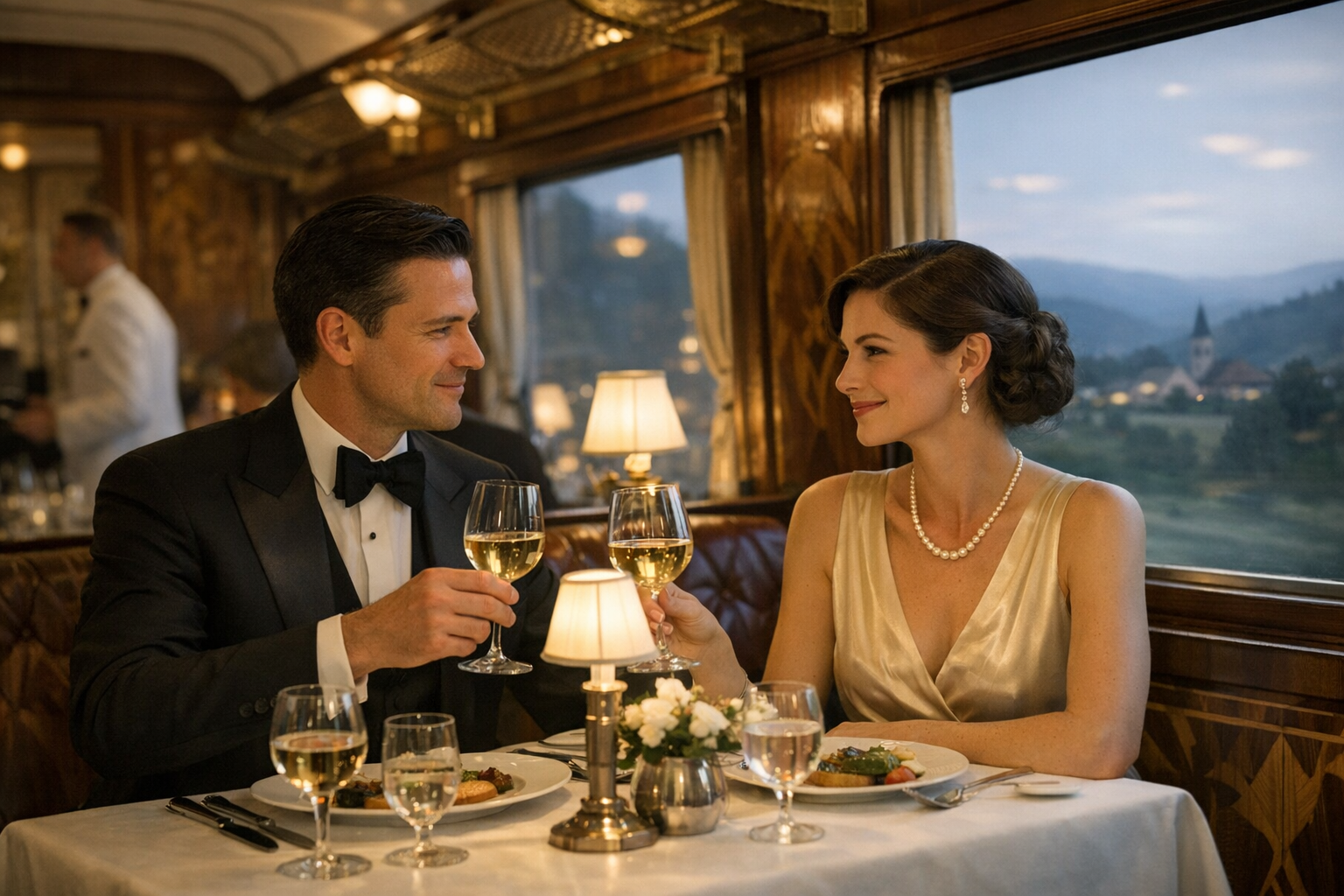
There is no neutral reaction to the Venice Simplon-Orient-Express. You either regard it as the pinnacle of travel romanticism — a working museum of interwar elegance that happens to move across Europe at night — or you find the price tag breathtaking enough to require a sit-down. Both reactions are understandable. What is beyond dispute is that Belmond's restored 1920s and 1930s carriages, with their hand-inlaid marquetry panels, Lalique glass fittings, and silk upholstery, represent something genuinely irreplaceable in the world of travel.
The classic route runs from Paris to Venice in approximately 24 hours, with departures available on specific dates throughout spring, summer, and autumn. Three dining cars — the Côte d'Azur, Etoile du Nord, and L'Oriental — serve multi-course dinners to passengers dressed for the occasion, while the 1931-built bar car (Carriage 3309) serves as the social heart of the train. All meals are included in the ticket price; this is not a journey where you're hunting for a sandwich.
For 2026, classic cabin fares for the Paris-to-Venice route begin at approximately €3,900–€5,500 per person. Grand Suites, which now include private en-suite bathrooms following a recent refit, run from €10,000 to €20,000 or more per person. The most significant news for 2026 is the partial reinstatement of the Istanbul service, with select departures running Paris–Venice–Ljubljana–Zagreb–Belgrade–Istanbul. The full journey takes approximately 60 hours, and fares begin at around €8,000–€12,000 per person. These departures sell out within hours of release — booking 12 to 18 months in advance is not hyperbole but a practical necessity.
No rail passes are accepted on the VSOE; this is a private luxury service operating on its own pricing structure. Travel insurance is strongly recommended given the investment involved. Belmond, owned by LVMH since 2019, manages bookings through belmond.com and a network of accredited luxury travel agencies. For travellers combining the VSOE with time in Venice, our guide to [luxury hotel stays in European gateway cities](/european-luxury-hotels-guide/) covers the best properties within easy reach of Santa Lucia station.
Journey 4: Flåm Railway — Norway's Steepest and Most Breathtaking Descent
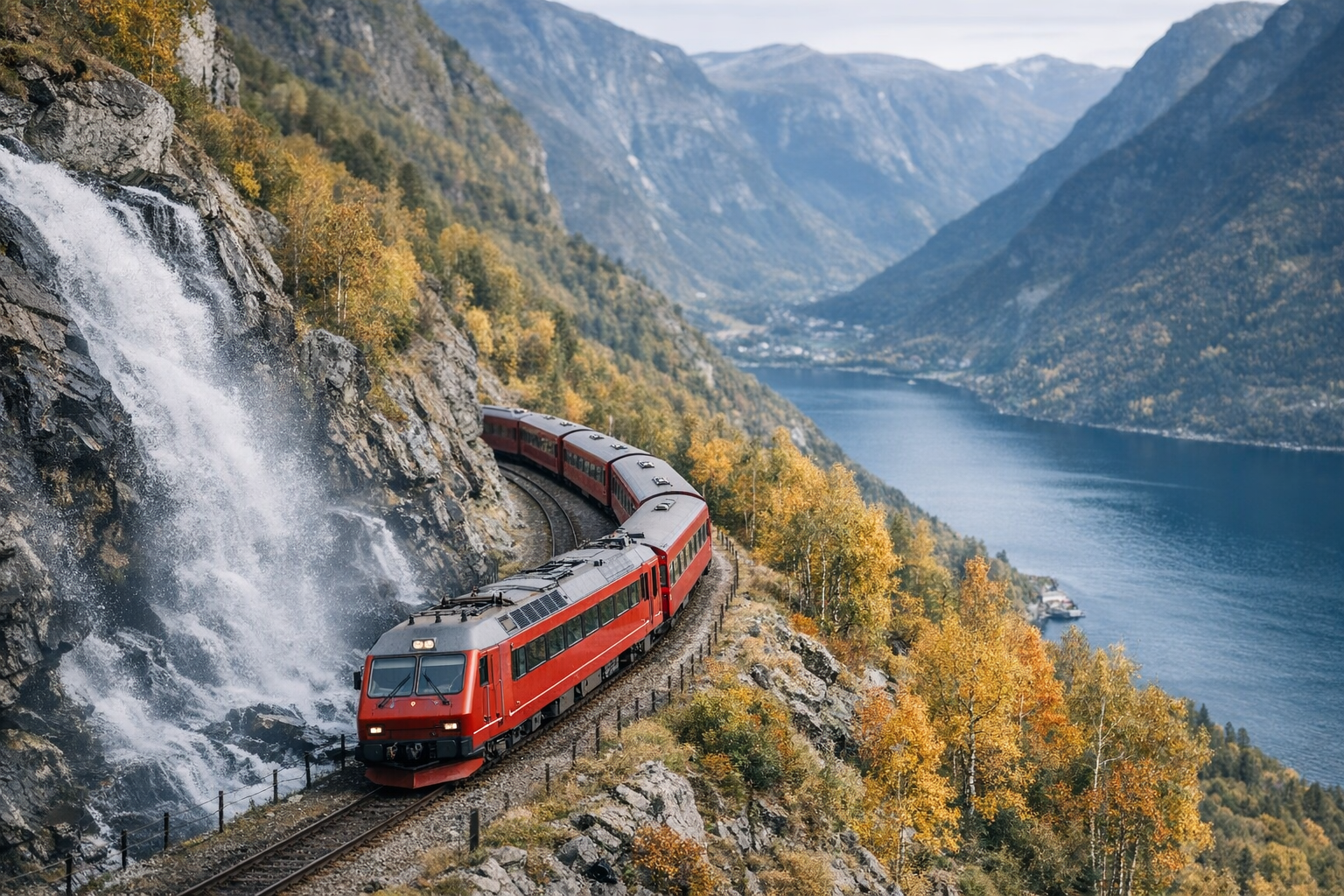
At just 20.2 kilometres long, the Flåm Railway (Flåmsbana) is the shortest entry on this list and arguably the most concentrated spectacle per kilometre of any railway in Europe. The line descends 865 metres in elevation between its mountain junction at Myrdal — where it meets the Bergen–Oslo main line — and the tiny fjord village of Flåm at the head of the Aurlandsfjord. For 80 percent of its length, the gradient holds at 5.5 percent, making it one of the steepest standard-gauge railways on the planet.
The journey takes approximately one hour in either direction, threading through 20 tunnels — one of which spirals 180 degrees inside the mountain to manage the gradient — and past waterfalls that in late spring and early summer pour off sheer cliff faces with extraordinary force. The most famous is Kjosfossen, a 93-metre cascade where the train stops for five minutes to allow photography. In summer months, a theatrical performance featuring a 'Hulder' — a figure from Norwegian folklore — takes place on the rocks beside the waterfall, which visitors either love or find charmingly eccentric.
A one-way ticket from Myrdal to Flåm costs NOK 350–450 (approximately €30–38) in 2026, with prices varying by booking timing. Eurail and Interrail passes are not valid on this line — a separate ticket is required regardless of your rail pass. The most popular way to experience the Flåm Railway is as part of the Norway in a Nutshell package, which combines the train with a fjord cruise through the UNESCO-listed Nærøyfjord and a bus connection back to Bergen. The full loop from Bergen costs approximately NOK 1,100–1,450 per person (roughly €93–123).
From Flåm, electric ferry connections operated under the 'Future of the Fjords' brand run to Gudvangen on zero-emission catamarans — a detail that matters increasingly to environmentally conscious travellers. The fjord cruise alone takes around two hours and costs approximately NOK 450–550 standalone. Book the Norway in a Nutshell package through fjordtours.com well ahead of summer travel; July departures sell out months in advance, particularly when large cruise ships are docked in Flåm. Check the port schedule at visitflam.com and aim to travel on days without a major cruise ship arrival.
For travellers planning overnight stays in Flåm, the Fretheim Hotel is the landmark option, with doubles from approximately NOK 1,800–3,500 per night depending on season. Pairing a night in Flåm with a pre-dawn walk along the fjord edge before the day-trippers arrive is one of the genuinely underrated travel experiences in Scandinavia.
Plan this trip
Journey 5: El Transcantábrico Gran Lujo — Spain's Slow Train Along the Green Coast
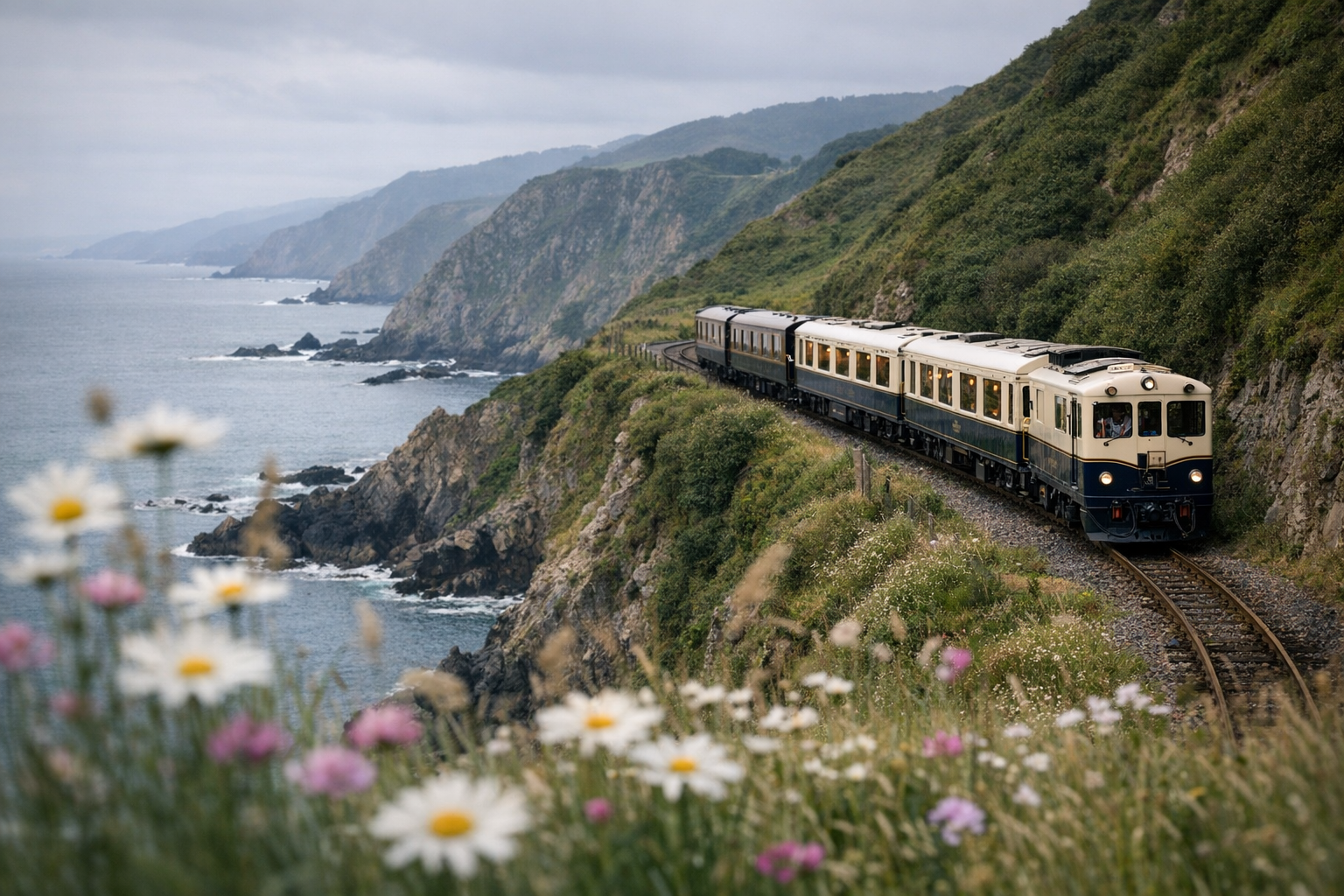
Northern Spain's coastline is routinely overlooked in favour of the Mediterranean south, which makes the El Transcantábrico Gran Lujo one of Europe's best-kept rail secrets. This eight-day, seven-night hotel train traverses approximately 1,000 kilometres of narrow-gauge track between Santiago de Compostela and San Sebastián, crossing four distinct regions — Galicia, Asturias, Cantabria, and the Basque Country — and stopping at a succession of destinations that range from world-class modern art institutions to medieval fishing villages.
The format is unusual: the train moves primarily at night, arriving at each destination in the morning so that passengers spend their days exploring on foot or by coach excursion. Stops include Oviedo for its pre-Romanesque churches and grand Gothic cathedral, the coastal town of Llanes with its natural sea pools (the cubos de la memoria art installation is unmissable), the mountains of the Picos de Europa National Park, and Comillas, where Gaudí's Villa El Capricho — his first major commission, completed in 1885 — stands in remarkable contrast to the surrounding Cantabrian countryside.
The journey builds to two outstanding finales. Bilbao delivers the Guggenheim Museum — Frank Gehry's titanium-clad masterpiece, opened in 1997 and still capable of stopping traffic — along with a pintxos bar crawl through the Casco Viejo. San Sebastián, the terminus, is widely regarded as one of the world's finest food cities, home to three Michelin-starred restaurants and a pintxos culture so refined that choosing a bar becomes a genuine dilemma.
For 2026, El Transcantábrico Gran Lujo is priced from approximately €4,000–€5,500 per person in double occupancy, inclusive of all meals (including excursions to local restaurants), guided tours, and luggage handling. The train operates April through October, with May, June, and September representing the best weather windows on a coastline that receives meaningful rainfall year-round. Bookings are managed through Renfe's luxury train division at renfe.com. Single supplements run 60–80 percent above the base price, a common feature of hotel train travel that makes this particularly well-suited to couples.
Travellers seeking a more affordable taste of the same narrow-gauge lines should consider El Expreso de la Robla, a heritage service running day excursions on overlapping routes at €60–€150 per day.
Journeys 6 & 7: The Caledonian Sleeper and the Douro Valley Line — Two More Not to Miss
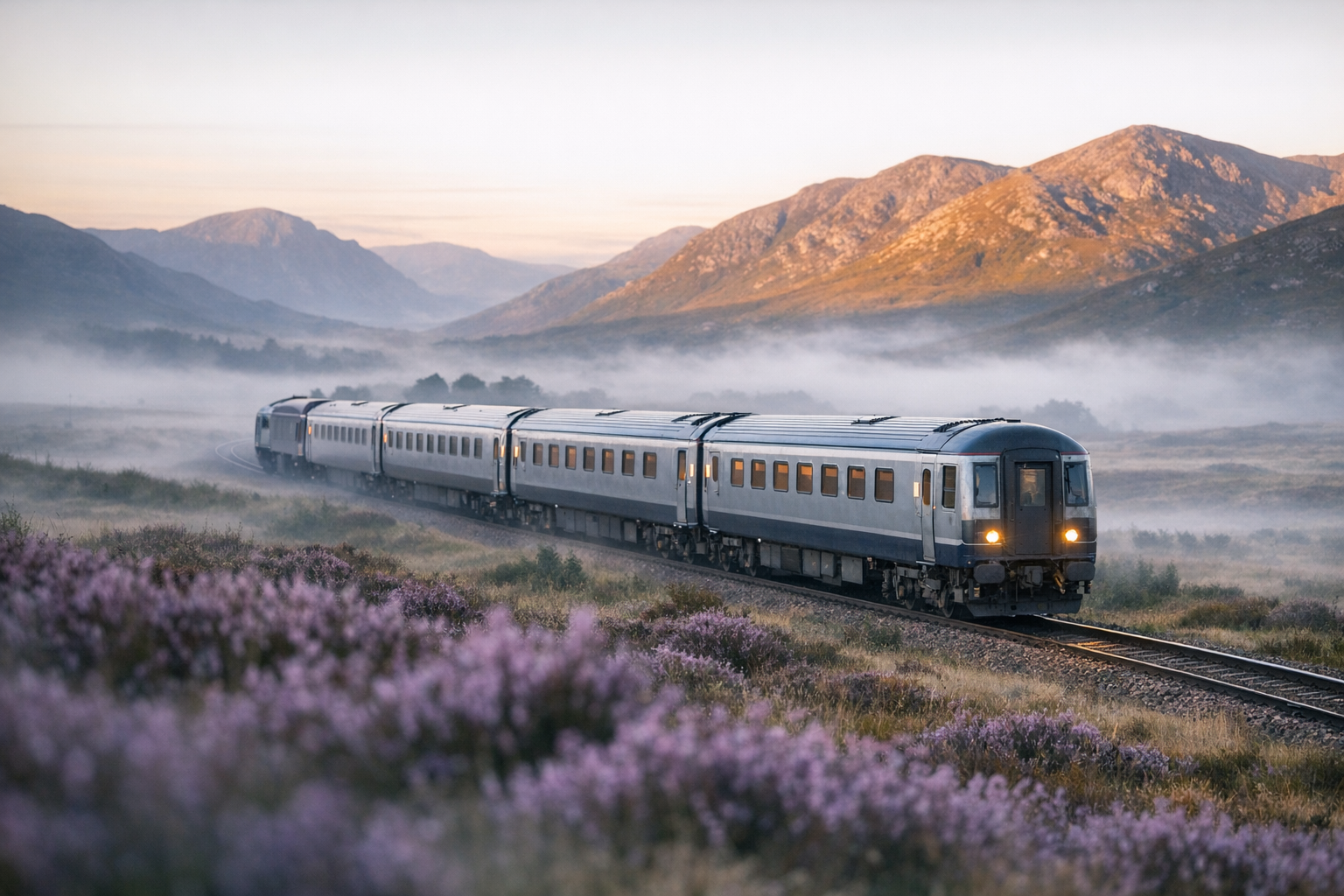
Scotland's Caledonian Sleeper deserves its place among Europe's most spectacular train experiences despite running almost entirely in darkness. Operated by Serco under contract to Transport Scotland, the overnight service connects London Euston with Fort William, Inverness, Aberdeen, and Edinburgh on a network of routes departing each evening Sunday through Friday. The Lowlander service covers Edinburgh, Glasgow, Stirling, and Perth; the Highlander routes push north and west into the Highlands, with Fort William passengers waking to the view of Ben Nevis and Rannoch Moor — one of the most desolate and beautiful landscapes in Britain — as dawn breaks over the boglands.
The 2024 introduction of Club and Caledonian Rooms — the latter being full en-suite doubles with Scotch whisky welcome gifts, turn-down service, and Scottish breakfast included — transformed the product from functional to genuinely aspirational. Prices for a Caledonian Room on the London–Fort William route start at approximately £275–£450 per person in 2026 depending on travel date and booking lead time. Standard berths in shared compartments start from around £75 per person. Book at sleeper.scot; summer dates sell out several months in advance.
For something warmer and altogether more pastoral, the Douro Valley Line in Portugal runs 175 kilometres from Porto's São Bento station — one of the world's most beautiful railway terminals, its main hall lined with 20,000 hand-painted azulejo tiles — east along the Douro River to Pocinho. The journey through the UNESCO-listed Douro wine region, with its steeply terraced vineyards and hilltop quintas reflected in the river below, takes approximately three and a half hours on the regional Alfa Pendular service and costs as little as €12–€18 per person.
The Douro Valley is Portugal's most celebrated wine country, producing port and Douro DOC wines from indigenous varieties like Touriga Nacional and Tinta Roriz. Several quintas (wine estates) along the route accept visitors, and the towns of Pinhão and Régua serve as overnight bases for travellers wishing to combine the rail journey with wine tastings and river cruises. Quinta da Pacheca in Régua and Quinta do Crasto near Pinhão both offer accommodation; doubles start from approximately €180–€350 per night depending on season. For travellers combining this with time in Porto, our guide to [planning a multi-city European rail itinerary](/european-rail-itinerary-planning/) covers how to sequence these journeys efficiently.
Plan this trip
Rail Passes, Booking Strategy, and Practical Advice for 2026
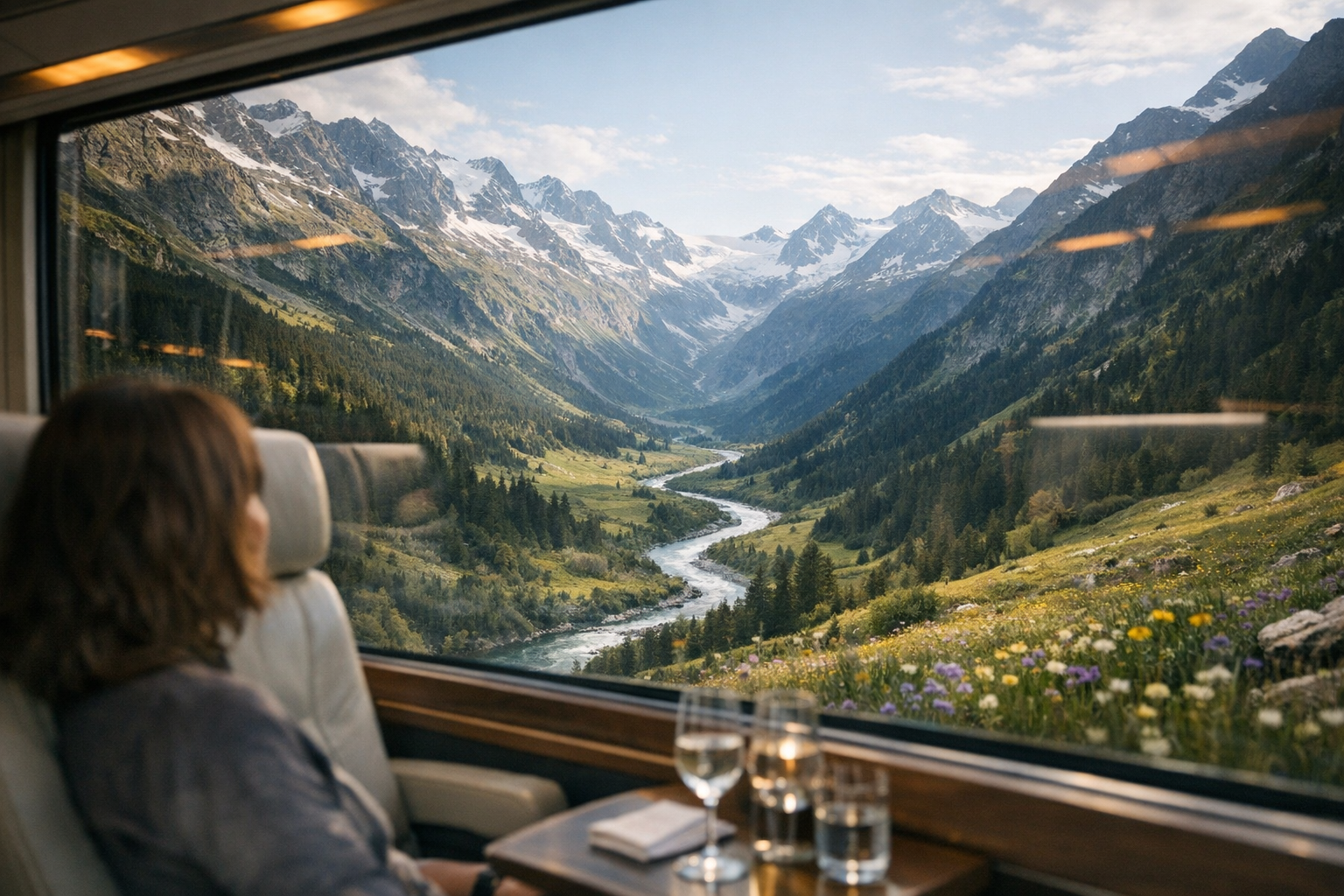
The single most important piece of advice for booking any of Europe's most spectacular train journeys in 2026 is to treat the reservation as seriously as the ticket. Many of these services — the Glacier Express, Bernina Express, Flåm Railway — require mandatory seat reservations regardless of whether you hold a rail pass, and those reservations carry separate fees and separate availability constraints. A Swiss Travel Pass covers the base fare on both Swiss routes but does nothing to secure your seat: that requires a separate booking through the operating railway.
For the Glacier Express and Bernina Express, the Swiss Travel Pass (available at sbb.ch) represents outstanding value for multi-day Switzerland itineraries, covering unlimited travel on SBB and partner railways plus free admission to more than 500 museums. A consecutive three-day Swiss Travel Pass costs approximately CHF 243 (roughly €255) in second class for 2026. Interrail Global Pass holders receive a 50 percent discount on base fares for both Swiss scenic routes — useful for travellers combining them with travel in Norway, Spain, or Portugal on the same trip.
For the Venice Simplon-Orient-Express and El Transcantábrico Gran Lujo, no rail pass applies. These are private luxury products priced in full from the outset, and the right booking strategy is simple: book early. Belmond opens VSOE departures on a rolling 12-month basis; Istanbul departures for autumn 2026 are likely to release in late 2025 and will sell within days. El Transcantábrico opens its season in January for the following April–October period.
For Norway, the Eurail Scandinavia Pass covers the Bergen–Myrdal leg of the Flåm journey on the Bergen Line but not the Flåmsbana itself. Budget accordingly. The Norway in a Nutshell package through fjordtours.com bundles the Flåm Railway ticket with fjord cruise and bus connections, which is the most convenient option for first-time visitors.
Finally, consider ground logistics at both ends of every journey. Arriving in Zermatt, Flåm, or Tirano on a tight schedule with heavy luggage is manageable by train but becomes considerably easier with pre-arranged transfers. Our overview of [European private transfer options](/european-private-transfers/) covers the key gateway airports and rail hubs where pre-booked cars make the difference between a smooth start and a stressful one. Europe's railways are magnificent — the journey to the journey matters too.
Frequently Asked Questions
By popular consensus and consistent rankings, the Glacier Express from Zermatt to St. Moritz in Switzerland is considered Europe's most spectacular train journey. The 291-kilometre route crosses 291 bridges and 91 tunnels, peaks at 2,033 metres at the Oberalp Pass, and features the iconic Landwasser Viaduct, a UNESCO World Heritage-listed structure. The Bernina Express and Norway's Flåm Railway are close rivals for sheer visual drama.
Yes. Reservations are mandatory for the Glacier Express regardless of whether you hold a Swiss Travel Pass, Interrail, or Eurail pass. The reservation fee costs CHF 16–49 per segment depending on the season. Swiss Travel Pass holders cover the base fare with their pass but must still book and pay for the reservation supplement separately through glacierexpress.ch or rail.ch.
Plan to book 12–18 months in advance for peak departures. The reinstated Istanbul service for 2026 is expected to sell out within hours of release. Classic Paris–Venice cabins in shoulder season may be available with 3–6 months' lead time, but Grand Suite availability disappears rapidly for any date. Book directly through belmond.com or via an accredited luxury travel agent.
No. The Flåm Railway (Flåmsbana) is not covered by Eurail or Interrail passes and requires a separate ticket purchase. A one-way ticket from Myrdal to Flåm costs approximately NOK 350–450 (€30–38) in 2026. The Bergen Line section from Bergen to Myrdal is covered by Norway passes and Global passes. The Norway in a Nutshell package through fjordtours.com includes the Flåm Railway ticket bundled with the fjord cruise and bus connection.
Late May through early June and September through early October offer the best balance of scenery, weather, and value. July and August deliver reliable weather and peak snowmelt waterfalls but bring the heaviest crowds and highest prices, with Excellence Class on the Glacier Express often booked out 3–6 months in advance. Autumn brings foliage colours; late spring brings wildflowers at high altitude. Both Swiss routes operate year-round with reduced winter schedules.
El Transcantábrico Gran Lujo is priced from approximately €4,000–€5,500 per person in double occupancy for the full 8-day, 7-night journey from Santiago de Compostela to San Sebastián (or reverse). All meals, guided excursions, and luggage handling are included. A single supplement of 60–80% applies for solo travellers. The train operates April through October; bookings open through Renfe's luxury train division at renfe.com.
Yes, and it makes an excellent itinerary. The Bernina Express terminates in Tirano, Italy, from where a local Trenord train runs to Colico on Lake Como in approximately 45 minutes. From Colico, ferries serve Bellagio, Varenna, Menaggio, and Como town. Alternatively, the Bernina Express Bus extends from Tirano to Lugano in approximately 3 hours for a further CHF 35. This allows you to travel from central Switzerland to Lake Como in a single day without backtracking.
The Caledonian Sleeper is an overnight train service operated by Serco connecting London Euston with Edinburgh, Glasgow, Aberdeen, Inverness, and Fort William. The premium Caledonian Room offers an en-suite double cabin with Scottish breakfast and whisky welcome gift. Prices start at approximately £275–£450 per person for London–Fort William in 2026. Bookings open 12 months in advance at sleeper.scot; summer and bank holiday dates sell out months ahead.